Wednesday, November 26, 2008

Consumer confidence plummets

No, this is not a post about the see-sawing global financial crisis and how it is hitting consumer confidence. This is about something else that is quite serious: plummeting consumer confidence in eggs.

Australia's consumer rights organisation, Choice, has named the Australian Egg Corporation amongst its ten 2008 Shonky Awards for misleading consumers about free range eggs.

It seems that the Australian Egg Corporation's definition of 'free range eggs' gives a rubber stamp to the treatment of laying chickens that doesn't meet what we would expect as 'free range' or even humane. According to the Corporation's standard for
free range, there can be 14 hens per square meter, whereas battery hens get 18 to the square meter. That is hardly much difference!

I feel duped – all this time, I've thought that the free range eggs that I'm buying from supermarkets and greengrocers are really from hens allowed to range free and treated humanely. Sure, I've heard the many arguments between free range breeders about accreditation, and whether free range egg farmers are any more humane if they de-beak their chooks, or lock them in barns at night (which actually protects them from the cold and predators, really) etc etc.

I certainly didn't expect the chooks to be crammed in at over a dozen to the square meter. If you think of a large egg farm, that is a lot of chooks crammed in the paddock.

Sure, I had my suspiscions about the veracity of the 'free range' claim when I've heard breeders insist there is no way the number of credible free range farmers could produce the masses of eggs being touted as free range on the market (and there are many claims and issues in this matter).

Because of this, I've tried to be more deliberate in my choice of free range eggs, and instead of relying on the picture of happy hens pecking in greed paddocks on the cartoon, to look for signs of more stringent (compared to the Egg Corporation's) assurance of free range: organic certification for one (but prohibitively expensive), and accreditation by Free Range Egg and Poultry Australia. Alternatively, you can buy your eggs direct from free range farmers, such as at CERES organic market (where you can see the conditions the chooks live in) and at farmers' markets.

But it is often not possible – especially when we're rushed or making last minute purchases, and the store we're at doesn't stock accredited free range eggs, so we end up grabbing the carton with the picture of happy chooks labelled free range and hope their claims are true.

I guess this story illustrates that there is no real excuse for sloppy shopping. Just as there is no excuse for slopping marketing.


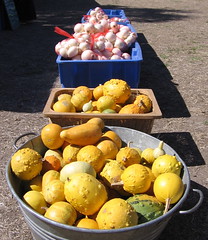
[Image by zoomar - under creative commons license]

Labels: , , , ,


Read more!

Monday, March 03, 2008

festival of fruit trees now up

The March edition on the Festival of Trees (which I'd mentioned earlier), with its special theme of Fruit Trees and Orchards, is now up at Orchards Forever. It is a great collection of posts on fruit trees and orchards that I'm going to enjoy dipping into over time.

I haven't had a good look at anywhere near all the posts, but I do find the festival is a bit American centric, and heavy on their preoccupation with apples (which I share to some extent), although it does feature a fair few British blog posts, and even a Portuguese blogger (in Portuguese), and a memorial post from a Polish-American writer living in Buenos Aires. Nice. I made it in too – listed as an Australian blogger, even – for my apple tree post.

I've enjoyed writing on a theme and deadline set by someone else. It also inspired another post on fruit trees in suburban Melbourne which I hope to polish off and post here sometime in the future. the other great thing is coming across all these other blogs an bloggers that I wouldn't have otherwise – a great way to break out of my reading habits and hear/read some 'new' voices. Even if I have to get used to unfamiliar accents.

I have to admit, though, that I am inspired to take the family apple picking this autumn. We will have to look for an orchard close enough to Melbourne whose crops haven't been devastated by the drought and where we can pick our own apples. We're going to the Farmers' Market at Collingwood Children's Farm this Saturday. Hopefully we'll get some ideas there!

Labels: , , ,


Read more!

Tuesday, March 13, 2007

The true price of food

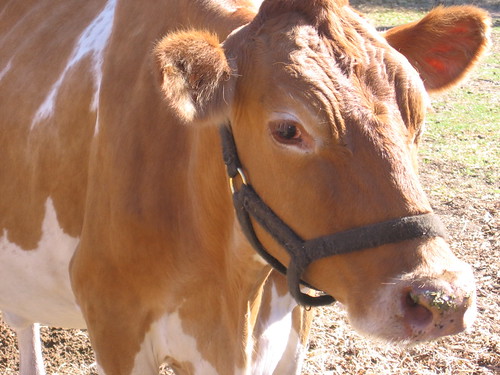
moo
On Saturday, my family and I went the the Farmers' Market at Collingwood Children's Farm for the first time in many, many moths. In fact it was my youngest's first time there, and he's now 10 months, so this trip was special. For while it used to be one of my favourite things to do, but it got harder to do as we changed gear for the baby.

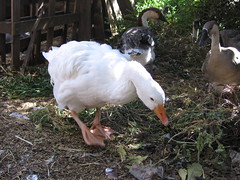
duckI remembered how much I enjoy the Farmers' market as I scoured the stalls for the best deals on freshly picked organic fruit and vegetables, revelling in the variety of vegetables not available at supermarkets or most standard market stalls. And visiting the farm animals.

The farm is more than a chance for the kids to happily negotiate their way through chickens, ducks and geese, watch a cow being milked (a first time for some), or pat friendly sheep. It is a way of getting to know where our food comes from.

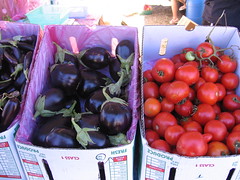
eggplant & tomatoes The best thing about the farmers' markets is not just the variety, or the chance of a deal on produce, but the opportunity to talk with the growers directly, and know that the money changing hands is going directly to the grower and not half-a-dozen middlemen. It is also a chance to learn something about where the food we eat comes from, and how much hard work farmers put into it.

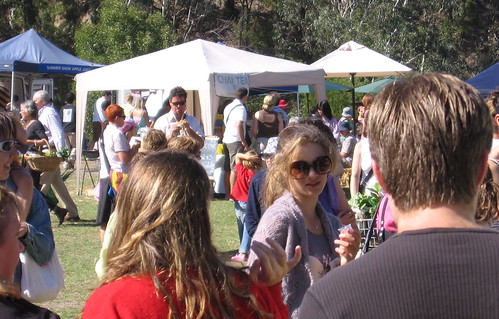
market crowd
I'm certainly not alone in this, as the crowds at last Saturday's market attest. Many, many people are keenly interested in where their food comes from, how it's grown, and who's behind it. Many see this as a tonic for a toxic culture of fast food, genetically modified food, or bland, featureless supermarket produce bred for shelf-life rather than for taste.

squashThe Age food writer John Lethlean describes this as about "having a relationship with the production and preparation of what we eat". For Lethlean, this interest is best encapsulated in the Slow Food movement.

Slow Food or not, my concern is predominantly with good food and food security – ensuring that our food, from the the growing and production of our food to how we turn it into a meal on our tables – is secure, free from the unfair domination by commercial interests, safe and environmentally sustainable. It is also a way of supporting farmers who want to do something different and break out of the supermarket supply-chain straightjacket.

This is especially the case for me with heritage varieties of vegetables and fruit. So it was particularly unhappy for me to learn that one of my favourite growers, whose heritage variety eggplants, apples, chillies, and other vegetables are so fabulous and fresh, will not be able to return to the farmers' markets after April, because she will lose her right to irrigation water later next that month.

organicsShe is a Mildura based grower, and this must surely be a result of the increasing pressure that the drought, the deplorable state of the Murray River and the worsening situation for irrigators is placing on farmers in the Murray-Darling Basin. Hearing this news first hand from the grower should sharpen in the mind of any city dweller the terrible conditions of the drought and the Murray River crisis poses for our farmers and the food we eat. It did for me.

You still here the odd complaint from shoppers at the farmers' market about the high price for tomatoes (organic) or other vegetables, but I'm learning to be more relaxed about such things. If I can't afford it, I don't buy it. I have learned to buy what is in season, and limit what I purchase to what my family and I can eat. But I think that more and more people are learning the true cost of food, and how the price we are paying for it at supermarkets does not reflect the cost – to the farmers, the environment and to our future food security.

The photos are by me, and you can see the rest of them on my flickr site.

Update: A good background on the Murry-Darling basin crises by
Peter Cullen is on the ABC website here. Some thinking and background on food security issues is available on the WorldChanging website here. If you're interested in food security, urban farms, food production and similar issues, the 4th Annual Australian City Farms & Community Gardens Network Conference is happening in Melbourne next week.

Oh, and I found and added the link to the Age article by John Lethlean, if you want to read the rest of his piece. I enjoyed it.

Labels: , , , , , ,


Read more!