Friday, August 08, 2008

"The world looks on with mixed emotions"

It is 08.08.08 – the eighth day, on the eighth month, of the eight year of this century. The Beijing Olympic Games open at eight minutes past eight Beijing time (just after 10 pm local/Australian Eastern Standard Time). This came in an email this afternoon from online campaign mob Avaaz.org:
As the Beijing Olympics begin, the world looks on with mixed emotions. It's a moment which should bring us closer together, and Chinese citizens deserve their excitement - but the Chinese government still hasn't opened meaningful dialogue with the Dalai Lama, or changed its stance on Burma, Darfur and other pressing issues.
That is pretty much how I feel about the impending opening of the Olympic Games in Beijing tonight.

I am torn about whether I
can keep my distance from the hoopla of the Olympics and resist wanting to immerse myself in the muck. Can I watch the proceedings from a distance as a bystander to the spectacle?

Can I avoid get dragged into the slipstream of nationalist zeal, jingoism, medal tallies, crass commercialism and the most grotesque types of hero worship, even if it is a constant jeremiad at how disgusting it is? If not, surely by day two or three of such criticism, everyone will be sick of it.

Can I retain a healthy critical objectivity about the Chinese government's Olympic celebrations without descending to shouting at the TV over China's orchestrated PR monstrosities to whitewash their terrible human rights record? And the Australian media's failure to notice? Is it possible to remain critical without spoiling everyone else's enjoyment of this spectacle?
I have a seven-year-old at home who is innocent to such things but is in awe at the impending celebration of all things sport. "It's the Olympics, Dad!"

Ask me in about a week.

Either way, today is an auspicious day for the Chinese, for whom symbolism and numerology means a lot, and it is worth celebrating.

I am glad that the sense of ambivalence is shared around the world. Following the Dalai Lama's example of extending a handshake towards China and the Chinese authorities, Avaaz.org wants us all to support their campaign to send a virtual handshake across the world to show solidarity with the people of Tibet, Dafur, Burma and China, and with all other peoples of the world, as "one last chance to reclaim the spirit of the Olympics, with the message of friendship and dialogue we share with the Dalai Lama."

Shake hands across the world with Avaaz.org and send a message to everyone that we haven't forgotten Tibet, Dafur, Burma, or the people of China.

[Image 'Chinese Red Lanterns' (cc) by
Abllo™]

Labels: , , ,


Read more!

Sunday, August 03, 2008

The boy from Katherine

Despite high hopes that he had more than a very good chance, Cadel Evans (centre in the photo above) did not win the Tour de France, and had to settle for second place for a second year in a row. I'm sure I wasn't the only one who wanted the whole thing to go away after that.

However, Cadel's recent announcement that he will not make the Beijing Olympics has rekindled the kind of media flurry only sports and entertainment celebrities (notice I didn't use 'actors' or 'sports-people' – deliberately) can elicit. A lot of the media attention has been on whether Cadel 'has what it takes' to win the Tour or win at Beijing (notice how 'choker' got trotted out a bit?).

Beaten by the Spaniard Carlos Sastre, Cadel seemed to struggle to keep his position after winning the yellow jersey a couple of times. So much was riding on him beating Sastre in the time trial last Saturday, Cadel's strong point, but he could not pull it off and it was Sastre who rode down the
Champs-Élysées in triumph.

David Tiley of Barista has written a profoundly insightful post on the Tour de France and Cadel Evans's failure to win. David's film maker's eye for camera work and the French TV coverage of the Tour opened up some new insights into the Tour for me, and into television sports coverage generally.

One of my favourite phrases from David's post is where he describes the helicopter filming the cyclists progress up the Alps and through the French countryside as "
like an airship rowed through the sky by elves”. I returned to the phrase over and over, almost wishing Miyazaki would take it and run with it.

But the clincher is David's analysis of Cadel’s weakness in riding the Tour, which made me flinch.
Cadel was never a competitor, never stamped his power and ego over the Tour. He was a capsule of averages, a moving wave of statistics who consistently did okay at the front of the peleton, always sustained by the fact that he is better at the time trial than the others whose performance is more uneven. While we hoped for the best, he was vulnerable to a mountain climber who learnt the mental discipline of riding like a steam train on the flat, off in some mathematical space which is really a meditation on rhythm.

Watching Carlos Sastre hurtle up the 13.8 km of the Alpe d’Huez, the toughest climb on the Tour de France, alone and peerless, as his CSC teammates dicked around with the peleton and Cadel just bobbed around in the flotsam, it was pretty obvious that the boy from Katherine is a one trick pony.

I so wanted to believe Cadel could win that it seemed disloyal to digest what David said. But in the end I had to agree – especially as I too noticed that while I watched Cadel (and then only a little) on TV, I couldn’t shake the nagging ‘back of the mind’ thought that he didn’t look like he could really do it, that he looked like he struggled up the mountains in a miasma of pain, rather than seem to almost float up as the leaders, and Tour winner Carlos Sastre obviously, did.

For all the fact that I find David's analysis so convincing, I find it odd how writers, and sports journalists especially, like to speculate on whether or not a sportsperson has 'what it takes' to win an event or perform at their best (and whether their best is good enough), as if the journalist has some great insight into the sportsperson's state of mind. But how different is David's insights into Cadel Evan's Tour campaign from the kind of media speculation that I mentioned at the start of this post?

I think sports psychology has a lot to answer for as thousands of armchair sports commentators and enthusiasts – and here I dob myself in for the dubious honour – pontificate on the worthiness and fitness of people to perform physical feats that we would be hard pressed to even start, let alone finish. And we are in for a feast of this type of commentary with the Olympics opening in less than a week: the hybrid of armchair psychology and couch potato sports-mania. Is this a case of 'those who can, do; those who can't, pontificate'?

Perhaps it has everything to do with heroes, and that thing we like to call the Achilles heel. We want our heroes to be great and to achieve things that we can only dream of. We want our heroes to
astound us and lift us up from our mundane lives of plodding domesticity and mind-crushing labour. And when they don't live up to the bargain we make with them – and it is a bargain: believe in me, because I believe in myself – we want answers. Explanations. Insights. And redemption – a reason to believe in them again, or in the next hero to come along.

Cadel Evans will always be to me the guy from Katherine who raced 'le Tour', crashed – more badly than they admitted, I reckon – but picked himself up to keep riding and finish that stage, and then woke up the next morning to ride again and win the yellow jersey. And won it again the next day. And I could never amount to a puff of breeze in his wake in the cycling stakes.

Perhaps Cadel will have another chance to show us that he is actually a strong bicycle racer with the heart of a lion, as speculation mounts that after withdrawing from the Games, he has another chance after all.

[Images courtesy of The Age's free Tour de France photos]

Labels: , ,


Read more!

Tuesday, March 18, 2008

Should we boycott the Beijng Olympics?

I think it is time to revisit the call to boycott the Beijing Olympics.

Various groups and campaigns have called for public boycotts of the Beijing Olympics, because attending the Olympics would be seen as turning a blind eye to the Chinese Government's domestic human rights abuses, and its role in the human rights abuses of other regimes. Foremost amongst these have been those campaigning for human rights and freedom in Tibet.

Reporters Without borders has information on the campaign to boycott the Beijing Olympics.

Not long ago, I supported the boycott call as a way to highlight how the Burmese military dictatorship is supported by China – in terms of political support, international legitimacy and trade dollars – and to pressure the Chinese to drop their endorsement of the Burmese regime, thus allowing the Burmese democracy movement room to breath.

More recently came the news that Steven Spielberg, following the example of other Hollywood celebrities, had pulled out of his involvement in the Beijing Olympics because many argued that such involvement was seen as an endorsement of the Chinese government – which was unacceptable in light of the Chinese's continuing arms sales to the Sudanese government, and how those arms are used to oppress the people of Dafur, and other minorities in Southern Sudan.

Now, according to ABC Radio 774 AM this morning, Australian Senator Andrew Bartlett has called for an Australian boycott of the Beijing Olympics because of China's brutal crackdown of protesters in Tibet who are highlighting China's brutal treatment of Tibetans in their homeland.

Now, you can consider how realistic a boycott of the Olympic Games would be – considering Rudd's attitude towards China, it is not surprising that Australia has rejected the call for an official boycott of the Games. Nor can we expect enough pressure to mount in this short time for other countries to formally boycott the games. In these changed geo-politics, we won't see the tit-for-tat Cold War tactics that led to the official Moscow and Los Angeles Games boycotts.

Howevever, in light of the brutal crackdown on Tibetan rights protesters, we must not allow China to once again brush off insipid international criticism and the
UN's glacial, byzantium manouverings of registering its 'concerns'.

The fact is, China will put on a multi-billion dollar pageant for the world in only a few months – in the guise of an international sporting competition – that will be a huge propaganda exercise to show a modern, stable, prosperous, peaceful – and unified – China. And we should not buy it. Literally.

In an age of consumer awareness and growing public consciousness, and the tools available to us, the possibilities of a consumer boycott of the Games are stronger. Don't go to Beijing for the Olympics, and if you, like me, can't afford to travel to China anyway to watch the Games, don't buy Olympics merchandise associated with the Beijing Olympics.

You can write lots of letters, emails and faxes to your Chinese embassy telling them this is how you feel and what you are doing, and write similar letters to your local papers, mention it on talk-back radio,
and leave such comments on blogs and online forums (as long as they are relevant to the topic, of course – I wouldn't endorse off-topic comment spam!).

You can tell your friends and family – especially if you know of people who are inclined to buy the inevitable sports clothes, tracksuit pants, predictable panda bear mascot and other paraphernalia emblazoned with the Beijing Olympics branding that we know will be made cheaply in Chinese factories with poor working conditions – that you don't want any of this stuff for either yourself or your kids (if you are parents), and why you think they should join you in boycotting it.

It worked with delegitimising South Africa's Apartheid regime, and it can work with China.

Let's not let China's regime off the hook for its deplorable human rights record.

[The image is of Tibetan monks who were beaten by Chinese security forces during the recent brutal crackdown on protests, from the ABC]

Labels: , , , ,


Read more!

Tuesday, December 12, 2006

It's not just cricket

I have the misfortune of having grown up in a former British colony that wasn't cricket mad. Unlike India, Pakistan, Sri Lanka, the West Indies or South Africa, the country of my upbringing was crazy about soccer (amongst other sports), but not cricket.

Oh, don't get me wrong. Cricket was played, but it was not a popular or widespread sport, and certainly not a game children played in the streets or backyards. In fact, I have no memory of ever seeing a cricket match either live or on television during my childhood.


What this means is that I have very little understanding of the finer points of cricket, and don’t play it at all well. I can't tell the difference between ‘long leg' and ‘short leg', and I have absolutely no idea where 'mid-on' is. After over a decade living in Australia, I do have an idea of how the game is played, but only a middling understanding of how it is scored or how a test proceeds. Strategy? Not a scratch. So much so that during the recent Ashes test in Adelaide, I had trouble keeping up with what was going on, while my colleagues could asses exactly how the day’s play had progressed and what the scores meant in an instant. I was left going, ‘What happened? What happened?’.


As the days get longer, the mercury climbs, and the cicadas warm up for their Hallelujah chorus, cricket takes centre stage in Australia and everyone from professors of literature to the packers at the supermarket warehouse becomes cricket mad and boffins of the game and Ashes arcana emerge overnight.


I realise, however, that I’m not alone in my ignorance. Many in Australia are unfamiliar with cricket’s finer points or simply dislike the game. Some just feel left out, or can’t comprehend the fuss. To an extent, my cricket handicap unites me with them, but it also resurrects the sense of being an outsider that so acutely accompanied my first years as a migrant to this country, and still lingers in many of my experiences of Australia. Where most who grew up in Australia would have played cricket at some time and some place as children, I didn’t have childhood experiences of the game.


In my father's school days and earlier, cricket was played in select boys' schools established by the colonial government. Of course, the British were re-creating their colonies in an image of their selves, down to the boys in white playing cricket on grassy fields, but this meant that the game found a footing in the country, however shallow.


Beyond Independence and the rejection of the culture of the Empire, the game barely survived in those institutions in which the British had left an enduring impression: some schools, the police, the universities, and various social and sporting clubs. There was even a national competition, but the state teams never approached the popularity or passion that my country reserved for soccer (or football, as we knew it). Soccer, despite also originating in Britain, could claim to be the world sport and so thrived.


In essence, this meant I had none of the classic Australian childhood experiences of backyard, school yard, or beach cricket, and none of the infatuation with Australia's cricket stars – and so none of the cultural capital that accompanies it all, and prepares one for Australia's summer obsession.


My inexperience with the game puts me at a disadvantage when it comes to explaining the finer points of cricket to my eldest son, who at six is developing an interest in the game. He's started ‘Milo have-a-go’ cricket workshops at the local cricket club. It’s a Cricket Victoria initiative in what I assume is an effort to encourage the participation of the next generation in their local clubs.


I can at least throw the ball (underarm) at him to bat, remind him which way the bat should face, and take my turn at batting when he has a go bowling. But I'm unable to explain 'lbw', or why the bowler has to yell 'Howzat!'. And I’m crap at catching the ball.


Where I’d thought it was okay for us to just have fun mucking about with the game the way I assumed most 6-year-olds and their dads did, I recently discovered that many Aussie dads are out there practicing over-arm bowling and batting in 'the nets' at nearby parks with their kids, and take their cricket quite seriously. While cricket doesn’t compare with the role of Little League baseball in US cultural lore and father-son dynamics, it does have its local significance in how boys are schooled in the ways of the Australian summer. When your father can’t catch or teach you to bowl, are you left out in playground games?


To an extent, my concern is whether my son will lack the necessary cricket skills, as I don't want him to miss out on learning the game and being included in the matches that will invariably spring up at school, or at the beach or park with friends and family as the summer progresses.


But I recognise there is more to it: some of these concerns stem from my anxieties about what it means to be a migrant in Australia and, by extension, being an outsider. It is also an anxiety about whether I can truly prepare my son to be at home in Australian culture – to not be an outsider through no choice or fault of his own.


So, in a way, I too have started ‘cricket school’. I go along on Saturday mornings with my son to his Milo cricket activity, throw and catch – or fumble – balls along with the other dads helping out, pay close attention when the instructor teaches something new, and try really hard to not look like a klutz.


But I still feel like I’m floundering. Perhaps I should just snap out of it and realise that at six, my son has many more years of summer cricket ahead, and thus a far greater chance of learning the game that will probably continue to elude me. Hopefully, when he’s 11, he can tell me all about it.

[Image from
Wikipedia: English cricketing legend WG Grace, from early last Century]

This has also been cross-posted at Sarsaparilla, as a guest post. Thanks Sarsaparilla!

Labels: , , ,


Read more!

Wednesday, October 04, 2006

Death of 'a brother'

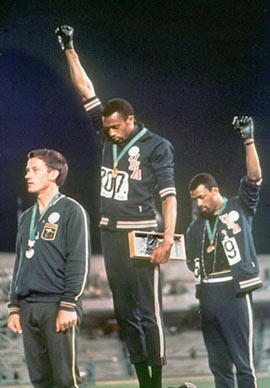
Peter Norman died yesterday of a heart attack. He was 64. He was the Australian athlete who won silver in the 200 meters at the 1968 Mexico City Olympics, but was more famous showing his support for the other medalists – African American atheletes Tommie Smith (gold) and John Carlos (bronze) – in their 'Black Power' salute on the winners podium.

It was a powerful act that the two African American athletes had planned to highlight the demand for civil rights for African Americans, and an enduring moment of the American Civil Rights Movement. What is less known is that Peter Norman supported them by wearing a badge of the Olympic Project for Human Rights (OPHR) when he joined them on the podium. Also, according to
Wikipedia,
Norman is also the one who suggested that Smith and Carlos share the black gloves used in their salute; it was originally planned for Smith to don both.
I heard ABC Radio current affairs show AM interview John Carlos this morning, who was understandably quite upset. Asked how he will remember him, the thing that stood out most in Carlos's description of Norman is where he called him 'a brother' – what I perceive as possibly the highest honour an African American who was in the struggle for civil rights could give a white man. It signifies Norman's – a priveliged white man – solidarity with African Amercans' civil rights struggle. Unfortunately, it's something that's possibly lost in translation today. Pity. Vale, Peter Norman – a brother.

[Image by AP via Wikipedia]

Labels: ,


Read more!