Saturday, October 10, 2009

Black-faced racism

When a group of Australian professional men – none of whom black – get together and paint up their faces black, wear large, black curly-haired wigs, dress in the style of '70s disco and R&B, and perform – very badly – a routine satirising 1970s African American family musical group the Jackson Five, you may think that they demonstrated more than just bad taste or a lack of good sense. You may, in fact, feel quite distressed at their racist portrayal of black people – not just African American people but all people of colour who have borne the brunt of white racism. This is quite likely if you are black, or a person of colour, yourself.

In such situations, you may express quiet disgust, you may walk out of the room during the performance, or you may, if you feel brave enough, have a word with one or two of the performers afterward and tell them why you think what they did was racist and wrong, and that they should rethink their attitudes towards African Americans, and black people generally. And it will likely be the subject of conversation amongst those who watched the performance for some time. Quite likely it will end there, or with a half-hearted apology from the performers and the excuse that they were just having a 'bit of fun'.

But when such an act is included in a variety program 'reunion' show broadcast on national television, with potentially hundreds of thousands, if not millions, of viewers, as it was last Wednesday night, you would surely wonder what this said about a country that condoned, celebrated, defended, and advocated such racist depictions and ridicule of black people.

Personally, I'm not really surprised that there are people who would perform such a show, and only a little surprised that Channel Nine broadcast it. I am certainly not surprised that the national conversation in Australia has been divided between those who are aghast and disgusted at the national broadcast of such racist ridicule, on the one side, and those who think it is all just a bit of humour and totally blown out of proportion by those too 'PC' to have a sense of humour and who should just 'get over it', on the other.


I am not surprised, but I am still angry.


I'm not surprised because I do believe that Australia has more than an undercurrent of racism that it not only denies, but actively cultivates. It is the vein of racism that runs under the inaction that allows child malnutrition and food insecurity to continue in Aboriginal communities while the country's richest city, Sydney, throws away AUD$1 billion worth of food a year. A vein that stretched across the string of desert, and now island, concentration camps where asylum seekers were indefinitely detained without trial.

It is the same vein of racism that Pauline Hanson open-cut into a bleeding sore, and that John Howard carefully capped and tapped, to draw on in an continuing drip, drip, drip that helped keep him in power on a wave of fear and hatred of invading asylum seekers, PC-police multiculturalists and dole-bludging blacks.


It is the same vein of racism that sees Aboriginal and Torres Strait Islander children removed by child protection authorities from their parents at over 8 times the rate of non-Indigenous children – over 10 years after the Bringing Them Home Report and over a year after the Apology to the Stolen Generations.

It is the same vein of racism that saw the Cronulla riots by white Australians expressing extreme racist sentiments and racist violence against Australians of Arab descent, and today sees South Asian international students and migrants, often working in low-paying jobs, fair game for racist attacks, muggings, and robbery.

No, I’m not surprised. But I am angry.

I am angry because this skit, this poor excuse for racist ridicule, was not an unfortunate slip-up of bad judgement by television executives. Channel Nine producers did not just 'let it happen', but in my opinion likely sought out the original performers of the skit broadcast 20 years ago on Hey Hey it's Saturday – when the men were medical students. More than a couple of people must have thought it a good idea to exhume the same group for the come-back show, with a triumphant ‘see where we are now’ punch line: all now medical specialists, with a urologist, anesthetist, and psychiatrist amongst them.

Until Channel Nine got egg on their faces and a clearly angry Harry Connick Jr criticised them for it on air. (The footage of both the skit and Connick’s criticism of it is online.) When Connick said on air, “we have spent so much time trying to not make black people look like buffoons, that when we see something like that we take it really to heart,” he wasn’t kidding. The media and opinion storm in the US has been huge, and overwhelmingly critical of the TV show and of Australia for perpetuating such racism.

Unfortunately for Australia, the criticism seems to have gotten white Australia’s collective back up, and instead of inspiring widespread reflection on the extent of racism in Australia, it seems to be provoking defensiveness and closed ears – as well as the current debate over whether the skit was really racist or just harmless Aussie humour. The opportunity for collective soul searching and effective anti-racism campaigning seems likely to be swamped by this debate.

If such an incident doesn’t prompt privileged white Australia to reflect on the extent of racism in this country, I’m not sure what will. I guess I’m inclined to agree with one of the American reactions reported in The Age:
"As a college-educated, African-American professional who confronts racism daily from cradle to grave, for no other reason than the colour of my skin; it is clear to me now more than ever, that racism against black people will never disappear but continue to be tolerated under various guises."

[Image: 'Poster for minstrel show, 1899', published on flickr by bobster855; used under Creative Commons license]

Originally written for Meanjin Journal's blog, Spike.

Labels: , , , ,


Read more!

Tuesday, September 08, 2009

Say a little prayer for me

Aretha Franklin, the Queen of Soul. Inspired by Mike Lynch's Top 100 women singers.

Someone's prayers are being answered. It's raining again in Melbourne. Lovely, wet, grey, soggy rain. The clothes on the line won't dry, but the trees and plants will be certainly greener. And hopefully the catchments a little fuller.

Labels: , , ,


Read more!

Wednesday, July 08, 2009

Manna from heaven

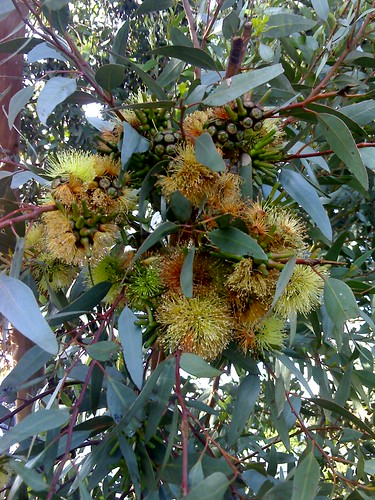
Gumtree blossoms on a cool wet morning

This afternoon I went along to a NAIDOC Week event hosted by a bunch of federal government departments. It wasn't the most community-oriented event I've been too – it appeared mainly targeted at those in community services or public service departments and agencies who work with Aboriginal and Torres Strait Islander communities in Victoria. I went to this event for work reasons.

It was still good because there were a fair few Aboriginal and Torres Strait Islander people working in either federal public service delivery or Victorian community agencies there, and it was good to meet and greet and see some faces behind the organisation's names.

But the nicest thing about the event was the speech and Welcome to Country by Aunty Joy Murphy, a highly respected elder of the Wurrundjerri, the traditional owners of the land on which most of Melbourne is on, and certainly of Fitzory where the event was held.

Aunty Joy treated us to a potted history of the elders behind the movement for Aboriginal rights in Victoria and the beginnings of NAIDOC, and how Fitzroy has been an important location for Victoria's Aboriginal rights movement and community-controlled services since the early 1900s. But it was her welcome message that gave me the most food for thought.

After she welcomed us in language, Aunty Joy told us that part of the welcome was based the importance of the Manna Gum to her family and the
Wurrundjerri people. Bearing a branch of green lush Manna gum leaves from her traditional country near Healsville, she explained that the welcome invited us to share in the community and its country – from the very tips of the gum leaves high in the sky, down to the roots deep in the earth.

Being someone who likes to visualise things figuratively, this appealed to me a lot. It is lovely to think of sharing in a thousands-year-old culture and its connection to the land in this way. To imagine our connection to the air and the leaves reaching out through it, as well as to the earth via the roots.

It also makes me wonder a fair bit about what we're doing to our ecology and to the climate in our carbon-intensive society.


Friday's NAIDOC March and Rally will be quite a different event – with lots more community, and certainly more issue and politically based – but I value this opportunity for reflection today. Thanks, Aunty Joy.

[Image: The photo is of eucalyptus blossoms I took at my suburban train station a little while ago. I have no idea what type of gum, though.]

Labels: , ,


Read more!

Thursday, June 04, 2009

Published

I am published.

Well, I've always wanted to finally be able to say that, and in terms of how the publishing world works, now I can. My short, short story 'How to Domesticate a Pirate [Live Fed Square Remix] has been published in the Remix My Lit anthology.

The anthology Through the Clock's Workings was edited by Amy Barker and published by Sydney Uni Press. You can buy it online from SUP (link above). There's an ebook of it floating around as well, but I can't find the link to it.

The anthology is part of the Remix My Lit initiative to encourage the creative exchanges, remixing and mutations of Creative Commons licensed creative works. Here's how they describe the anthology:

A world first! The first remixed and remixable anthology of literature.

This anthology of short stories is not some textual tome, frozen in time and space. It is alive, evolving organically in a constant state of flux. Why? Because each story is available under a Creative Commons licence, giving you rights to share and reuse the book as you see fit.

The stories are great They are excellent examples of what collaboration and creative sharing and remixing can do to creative interesting writing and works of art. I urge you to buy the anthology.

My story is a remix of a 'Remix My Lit' story by Danielle Wood, which is also included in the anthology. The stories and the whole anthology are published on the Creative Commons Attribution-NonCommercial-Share Alike 2.5 Australian license.

My remix was part of the live remixing event at Federation Square at last year's Melbourne Writer's Festival, which I blogged about. You can read the original version of my remix story as I'd published it on this blog then. I think the edited vesion in the anthology is better, though. It's short, but I had a lot of fun with it.

I'd heard much earlier this the year that my story had been selected, and it went through the editorial feedback process etc, but the publisher had asked contributors not to say anything publically until the launch. Well, I've just heard that:
Through the Clock’s Workings was launched at the Copyright Future: Copyright Freedom Conference at Old Parliament House (OPH) in Canberra on Wednesday 27th May by Dr Terry Cutler (Cutler and Co Melbourne).
Would have liked a bit more notice, but can't be too fussy, can I?

When I think of the idea that I am 'finally' a 'published' writer, I wonder what that means about the eight years and more that I have been writing, editing and publishing (and desktop publishing) in my previous and current jobs. Working in the community sector, I have written, co-written, ghost written, edited and published a lot of material for the organisations I work for, particularly currently. But I guess that doesn't seem to count as 'being published'. More than half the time, my name isn't put to much that I write. Not because I'm not proud of it, but because it's written and published under the organisation's name, or its leadership's. I'm okay with that. It's what I've signed up for. It's pretty much what 'communications' and much of project work is (and I'm finalising a really big one right now!). And I care about this work.

At times such as this, though, when a one-page story is published in an anthology and I'm publically credited as the author, and it is my first published piece of fiction, it makes me think of the reams of content I've written and edited that don't have my name to them. They are still my creative enterprise, and have a large part of me in them.

The image of the cover of Through the Clock's Workings is designed by Ali J and is creative commons licensed.

Labels: , ,


Read more!

Tuesday, May 26, 2009

Australian filmmaker wins Camera d'Or

Congratulations are due to Warwick Thornton, whose first feature film Samson And Delilah has been awarded the Camera d'Or prize at Cannes. The award is for a first-film by a first-time film director.

El from elswhere has previously reviewed the film and its Extraordinary premiere in Alice Springs at Sars Lite, and I highly recommend it to those who missed her post.

I am somewhat disgruntled, though, that the media keeps referring to Thornton as an Aboriginal filmmaker. I know, and respect the fact, that Warwick Thornton is a proud Aboriginal man, who is strongly connected to his family and community in Alice. But why aren't Australians, and our media, ready to simply celebrate our writers and filmmakers and artists and musicians (and their achievements) as art makers first and foremost, and then, yes, Australian, and, yes, certainly Aboriginal or Torres Strait Islander if they are of that background?
[Yes, there's more! Click on 'Read more' to read the rest of this post!]

Why are the media reports of his win constantly referring to 'Aboriginal filmmaker Warrick Thornton'? Why not 'Australian filmmaker'? Am I too sensitive in presuming an undercurrent of 'wow, he's managed to win it despite being Aboriginal'?

Is Thornton being Aboriginal the story, or is how good a film Samson and Delilah is the story?

Yet Samson and Delilah is constantly referred to as an Aboriginal film. Surely it is that but more, and everything else besides? Thornton himself considers it a love story first and foremost (and at least The Age picks that up in the headline 'Australian love story wins Cannes prize'), and yes its actors, characters, setting and plot drivers are Aboriginal, but surely this is not a only, or purely, an Aboriginal film?

If anything, the jury at Cannes seems to get it, describing it "as the best love film they had seen for many years."

I don't doubt that Thornton being Aboriginal is important to his approach to and success in the film – possibly securing him access to country, actors, community support, and certainly the context for the story – and it is unlikely that non-Indigenous filmmakers would have had the opportunities and entrepoints to make this project a success (though that is debatable, looking at David Vadiveloo's success with the online film/multimedia production UsMob). I have no doubt that being Aboriginal is important to Thornton, and has informed and coloured his practice as a filmmaker.

But perhaps, first and foremost, Thornton is a very fine filmmaker. And he was won a major prize at Cannes.

You can hear Thornton speaking to the ABC's Lisa Millar (links to audio mp3) about his reaction to his film winning the Camera d'Or and, endearingly, how he's ready to come home from the red carpet glitz of Cannes to reality and sit on his veranda in Alice Springs .

Cross-posted at Sarsaparilla Lite.

Labels: , ,


Read more!

Friday, March 20, 2009

If you were missing Sarsaparilla - fear not

If you've been wondering what happened to Sarsaparilla over the last couple of months, and wondered if what seemed like a summer hiatus was turning into a winter of neglect, fear not as Sarsaparilla will be back - prettier and better.

Sarsaparilla is a group blog on literature, the arts, culture and public comment from an Australian perspective, and which I recently joined as a regularly contributor late last year.

The team at Sarsaparilla thought a spruce up and re-design was warranted, but a few things broke in the process, meaning things were taking a lot longer than we expected to get it up and running again.

However, we've recently launched a temporary site, Sarsaparilla Lite, to keep our audience's hunger pangs at bay, and to satisfy our creative juices.

And it already displaying the Sars team's excellent insights into dance and performance, television, film, public art and literary awards, and I'm sure there's plenty more to come. So do enjoy this coffee and hot buttered crumpets before you get stuck into the full cooked brekkie.

Labels: , , , ,


Read more!

Tuesday, March 17, 2009

The devil you know

Late last month, I came across a BBC online photo essay that immediately brought back memories of my undergraduate study of Anthropology. Considering that study was some 10 years and more ago, I think that was pretty remarkable.

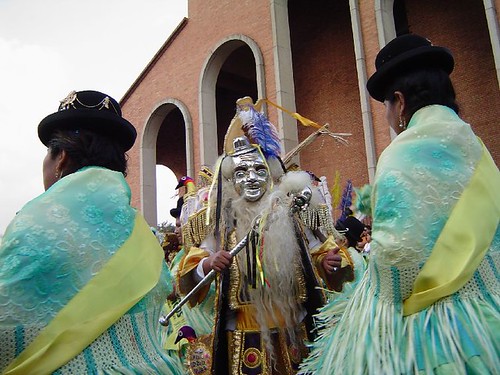
The photos were of La Diabldada Festival in Oruro, Bolivia, and feature the gloriously detailed and colourful devil masks and costumes of the festival and its parade. The festival is a strong expression of the pre-Columbian Andean traditions, mythology and ritual that remain strong features of Bolivia's Andean people.

'oruro' by OVRL - devil costumed and masked performer in Bolivia

One of the first things I did was explore whether the massive flickr community also had photographs of La Diablada and the Bolivian Andean community who celebrate the festival. You wouldn't begin to guess the jackpot I hit. I also set it as a task of 'using my degree', something I periodically give cause to obsess about (considering I put a lot of energy, time and resources into completing it!

I was amazed how many photos were published on the Creative Commons license. All the photos here are Creative Commons-licensed photos found on Flickr.

'oruro' [2] by OVRL - devil-costumed performers at carnaval de oruro in Bolivia

When I saw the photos and remembered my second year Anthropology studies, I wondered how much things may have changed in the 17 years since I studied anthropology at university. I was particularly interested in how much the increased accessibility in travel, and the way the internet has allowed an explosion in the sharing of stories, photos, experiences and knowledge of things – including festivals, traditions and rituals – in places we may have once considered distant, unreachable and the domain of the brave few who ventured to explore them, or the isolated people who live these as daily
realities, has affected how we 'know' the world around us.

'Cholitas dançam la Diablada' by Cltn - colourfully masked and costumed dancers on parade

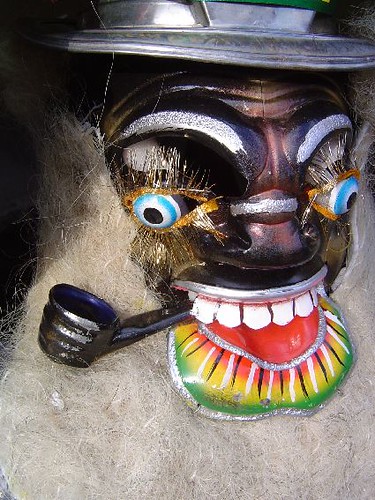
'Máscara de Morenada' by Cltn - masked performer at what appears to be a festival by Bolivians in Sao Paulo, Brazil

The internet has brought together
online the experiences and stories of people across the world, and their documentation and publication under creative commons licenses.

Not withstanding the concerns with the accuracy of much of this information, this development allows other writers, bloggers, media makers and other armchair sticky-beaks like me – and more importantly students and academics – to use them with the freedom that creative commons licenses offer. How much can the internet, social networking, blogging and creative commons licensed content creation and sharing improve teaching in universities? How much is this also unreflexive voyeurism? Perhaps that's the topic for another post.

What I do know is that I certainly did not get to enjoy the colour and vibrancy of these images to assist me in understanding what we were learning in anthropology. I wish I had access to these images then.


'Jallalla...!!' by mabel flores - Bolivian miner offering a salutation with beer

The Andean people in these parts of Bolivia have historically been the working backbone of Bolivia's now declining tin mining industry. The ethnogography, by Michael Taussig, we studied in second year anthropology examined how the devil featured in Latin American working class and peasant communities and expressed their experience of the brutality and exploitation of Latin American capitalism. According to wikipedia, in The Devil and Commodity Fetishism in South America:
Taussig … argues that through the devil, peasants express their recognition that capitalism is based on the magic belief that capital is productive, when in fact capitalism breeds poverty, disease, and death."

photo by orianomada - a miner in an underground mine in Oruro, Bolivia

As developing countries, and mining communities in particular, suffer in the agonies and conflagrations of another global economic crisis, and communities are threatened by the flight or collapse of capital or falling commodity prices, I also wonder to what extent the internet can contribute to bearing witness to their struggles and document their traditions.

El tio de la mina, Oruro by germeister - shrine to the devil of the mine, El Tio. Such expressions were a central focus of enthonographies of the 1980s.

Galeria del museo etnologico de los mineros, Oruro by germeister - mining museum, Bolivia

Or whether the internet will just become another type of museum. Not that there's much wrong with museums (that are reflexive of their work and role in cultures). I guess the opportunities the internet offers us is more ways to engage with the content online, and with other people creating and sharing this content.

By the way, did I tell you how much I really enjoyed Barista's excellent, highly informed and exploration of the Chinese demon-catching god? (It is
beautifully illustrated by illustrations now in the public domain.) Or Sophie Cunningham's amazing photographs of the Balinese festival to banish bad demons? How remiss of me.

Labels: , , , ,


Read more!

Wednesday, March 04, 2009

Shortlist for Commonwealth Writers' Prize

The Commonwealth Writers' Prize 2009 Shortlist has been announced, with a selection of writers across the Commonwealth nominated in the Best Book and Best First Book categories.

From Australia, they've stacked up Aravind Adiga of
White Tiger-Man Booker fame against Helen Garner, Joan London, Christos Tsiolkas and Tim Winton for the Best Book prize. Wow. I don't want to be taking bets on this one.

They've also stacked up Nam Le (for The Boat) and a bunch of other firsties against Aravind Adiga again, this time for The White Tiger, for Best First Book. You'd think though, since Adiga won the Man Booker for The White Tiger that they'll lay of him for a while and let some other writers have a chance? Not that I'd put money on it, but I do hope that Nam Le wins it – I think The Boat is a brilliant collection of stories.

I don't get why Aravind Adiga is listed amongst those from Southeast Asia & Pacific. Wikipedia states he has dual Indian and Australian citizenship, but he lives in Mumbai now, so … what gives?

The shortlistees from Southeast Asia & Pacific for Best Book are:
  • Aravind Adiga (Australia) Between The Assassinations - Atlantic Books
  • Helen Garner (Australia) The Spare Room - The Text Publishing Company
  • Joan London (Australia) The Good Parents - Random House Australia (Vintage Imprint)
  • Paula Morris (New Zealand) Forbidden Cities - Penguin New Zealand
  • Christos Tsiolkas (Australia) The Slap - Allen and Unwin
  • Tim Winton, (Australia) Breath - Picador
I'm interested to see that a Malaysian author, Preeta Samarasan, has been shortlisted for a First Book Award too, for Evening is the Whole Day. I'm a little perterbed that it sounds like it's in the Arrundathi Roy-Amitav Ghosh-and dare I say it, Aravind Adiga mould, but I shouldn't be surprised considering current literary tastes.

I wonder when we will get past writers of Asian and African decent getting gongs for more stories of jungles, plantations, wild animals and bizarre families and cross-generational/cultural conflict, while white authors continue to be lauded for angst-ridden kitchen table dramas. I'm getting tired of how the empire is still enamored with the heyday of its plantations and coolies. Hm, is that too harsh?

The
Commonwealth Writers' Prize website seems to be crashing, probably due to the heavy demand to see the shortlist, so check out Readings online's news of the 2009 Shortlist, including links to their reviews of the books where available.

I'm waiting to borrow White Tiger from a colleague. What will you read next? Anything from the shortlist?

Labels: , ,


Read more!

Wednesday, January 28, 2009

John Updike dies at 76

US novelist John Updike died on Tuesday, aged 76. He lost his battle with lung cancer.

The two-time Pulitzer Prize winning author was highly prolific, and wrote novels, short stories, non-fiction and verse. Updike was famous for his keenly observed, sharply rendered and insightful narratives of middle America’s domesticity and family life.

As he put it once, “When I write, I aim in my mind not toward New York but toward a vague spot a little to the east of Kansas.”


Updike also pursued a realism that placed sex and sexuality squarely in the middle of his characters’ lives and thoughts, just as they are in the centre of all our lives. Some thought he took the sex too far, though for different reasons. The prudish British dubbed Updike the ‘laureate of lewd’, while other critics nominated him – repeatedly – for the Bad Sex in Fiction Award.

However, it’s worth remembering that in the 50s and 60s, Updike was pushing the boundaries of moral prudery and taboo over sexuality in a country and time where many saw Rock ‘n Roll as the work of the devil.

He made no apologies for putting sexuality in the middle of his stories:
“I think taste is a social concept and not an artistic one. I’m willing to show good taste, if I can, in somebody else’s living room, but our reading life is too short for a writer to be in any way polite. Since his words enter into another’s brain in silence and intimacy, he should be as honest and explicit as we are with ourselves.”
I think that some of Updike’s finest work is in his short stories where he explores small town life and burgeoning adolescent sexuality and angst with more restraint and nuance, yet great honesty.

His two Pulitzer Prizes for fiction were for his famous Rabbit series of novels (beginning with Rabbit, Run in 1961) featuring the middle-aged, middle class, middle America suburban antics of high school football hero turned car salesman Harry "Rabbit" Angstrom. Some of his other famous works were The Centaur (1963), The Witches of Eastwick (1984), and The Widows of Eastwick (2008).
“Writers take words seriously-perhaps the last professional class that does— and they struggle to steer their own through the crosswinds of meddling editors and careless typesetters and obtuse and malevolent reviewers into the lap of the ideal reader*.”

— John Updike, Writers on Themselves (1986); Wikiquote

* Whoever that is...


Obituaries elsewhere

‘A Relentless Updike Mapped America's
Mysteries’, The New York Times, 27 January 2009

'Rabbit is gone: Updike's wit, frankness remembered', ABC News Opinion, 28 January 2009

[The image is a Magnum one... shhh...]

Labels: , , , ,


Read more!

Friday, November 21, 2008

Double-Oh-Trouble

I am quite positive that more than a few of us are James Bond fans. We probably just don't want to admit to it publicly. Perhaps its because many of us don't wish to admit to enjoying action movies, or spy thrillers at that. Perhaps its because so many of the James Bond films were schmaltzy, kitsch, glitzy or just plain dumb.

The current commercially-induced James Bond fever, sparked not insignificantly by the recent release of the latest in the Bond film franchise (which will remain unnamed in my vain attempt to thwart Google's page ranking search mechanisms), offers a great excuse for closet Bond fans to come out in the open and share what they love about the 00 agent from M16.

Sure, I'll admit it. I enjoy James Bond movies. With some of the best gimmicks and devices that have been the stock-in-trade of spy films, fancy cars, hammed-up bad guys, amazing futuristic sets for the bad guys' lairs (especially in those films made in the 60s and 70s), some pretty out-there stunts, and a chance to see the Bahamas, the Caribbean, the Mediterranean, the Alps, Africa, or even glimpses behind the Iron Curtain (that were not) on the silver screen, plus a dozen episodes of Lifestyles of the Rich and Famous rolled into one movie, I was more than happy to wallow in whichever film in the franchise was on television or at the cinema at the time.

Absolutely, I share many of the criticisms and apprehensions of this big-budget, money-spinning, action movie film franchise that has over the years demonstrated a great deal of misogyny, Cold War hyperbole, and extreme violence and bad sex on the big screen.

But I just can't help but reflect on the extent to which the last quarter century of James Bond movies has permeated popular culture and imbued itself in my childhood. They became part of my childhood play, imagination, and cultural patois.

The Bond films have become entrenched in popular culture, to the extent that the various cultural references to the films have become so clichéd that others refer to them in self-referentially clichéd ways – sometimes to good effect (the Austin Powers franchise). And for all their pop-schmaltziness, the makers of the Bond movies would usually try to fit in some political comment on issues of the time, however tokenistic or shallow the effort was.

So here goes. To assist those closet Bond fans come out, I'm framing the rest of this post in terms of some Trivia questions. Please feel free to join in.

Favourite Bond song
I'm tossing up between 'Goldfinger' by Shirley Bassey (from Goldfinger) and 'Live and Let Die' by Paul McCartney (Live and Let Die)

Favourite Bond bad-guy
Hmmm. Probably Dr No. But I haven't made up my mind, really.

Favourite Bond bad-guy's henchman
Originally, I couldn't decide between Jaws from Moonraker and the butler who decapitated people with his bowler hat (name and movie forgotten), but now I'm leaning toward Robby Coltrane as the ex-KGB spy turned Russian gangster who started appearing in GoldenEye.

Favourite Bond gadget
The gondola that turns into a hovercraft. Can't remember which film though, but that scene is set in Venice, of course.

Favourite Bond female lead
Natalya Simonova, played by Izabella Scorupco, the Russian computer programmer who helps defeat the geeky bad guy in GoldenEye.

Favourite Bond M16 hack
I really can't decide between John Clease as Q and Dame Judi Dench as M. I'm leaning for Judi Dench.

Least favourite Bond film
I'd have to think very hard about this, because while there are many scenes, plot-lines and characters I dislike in many of the films, I'm not enough of a fan to know them thoroughly to work out which one I hate the most.

Favourite actor playing James Bond
Without a doubt, Sean Connery.


What about you? And what Bond trivia questions would you add?

Cross-posted at Sarsaparilla.

Labels: , , ,


Read more!

Wednesday, November 12, 2008

A lucky but well deserving chook

Nam Le has won the Dylan Thomas Prize for young writers for his story collection, The Boat. Congratulations, Nam!

According to the folks at the Dylan Thomas Prize, the prize is to "recognize the best young writer in the English-speaking world and ensures that the inspirational nature of Dylan's writing will live on." They mean writers under 30. That's very nice, but the £60,000 would come in very, very handy too. That's AUD$140,000! From what I gather from this morning's Radio National Breakfast show, it is one of the richest and most prestigious literary prizes for young writers globally. You can hear Nam Le talking about this prize in his usual self-deprecating style to Radio National's Fran Kelly this morning – if you hurry and before RN take the audio off-line.

Writer Nam Le at Mossman Library
Nam Le has certainly made a splash in Australia and around the world for his first book, The Boat, a collection of short stories – some of which are short in name only. He drew a very big crowd at this year's Melbourne Writers Festival, and his packed-out conversation with Sophie Cunningham was transmitted live by satellite to the Edinburgh Festival of Books, and I believe The Boat was one of the highest selling books at the Festival. It is certainly one of the highest selling books of short stories in recent years.

And he's been winning a slew of awards, honours and prizes. Yet, however much prizes such as the Dylan Thomas claim to celebrate the best, they are pretty much just competitions, and there are many, many young writers out there slogging it and coming within Cooee of the Dylan Thomas. Even Nam Le is pretty low-key about the significance of this recent prize. As he told Fran Kelley on RN this morning, literary prizes are a chook lottery, and he happened to be the lucky chook this time.

Nonetheless, he is a good writer, and he deserves it. But for all the talk of Nam Le's talent, which I sincerely admire, his emergence from the prestigious Iowa Writers Workshop, his rise to fame with The Boat, and his success as fiction editor of the Harvard Review, I think it is important to take some perspective in remembering where he came from.

No, I don't mean so much Australia, where he grew up, or Vietnam, where he was born and from which his family fled by boat when he was a three-month-old baby (although the Dylan Thomas Prize strangely describes him as a "critically acclaimed Vietnamese writer" rather than an Australian writer...). Though I do think that for a Vietnamese refugee boat person to be a good writer and make it good on the Australian and world literary stages is a great achievement to be celebrated.

What I mean is where Nam Le's stories were first published, and where we – Australian readers particularly – first encountered him.

I first heard of Nam Le when I was blown away by his story 'Love and Honour and Pity and Pride and Compassion and Sacrifice' in The Best Australian Stories 2007, edited by Robert Drewe. Before that, its first Australian publication was in the magazine Overland, and before that it was published in the US Zoetrope: All-Story.

And I don't mean it lightly when I saw blown-away by that story when I read it last Christmas. So I am truly grateful for Drewe picking the story for the collection, though he would have been foolish not to. And I'm very grateful that Overland published the story first in Australia. In fact, of all the previously published stories collected in The Boat, only 'Love and Honour…' had been previously published in Australia.

And here is the crux of my rant. If it weren't for Overland publishing that story in Australia – and going on publishing more and more Australian stories each edition – and Robert Drewe picking it up in time to be packaged by Black Inc for a whole lot of Australians' Christmas/Summer reading last year, I wonder if I would have heard of and been impressed by Nam Le as I was. And I wonder if his writing would have made such an impact on me as it did.

And I wonder if I would have liked The Boat as much as I do.

Seems to me we need more magazines and places for short stories to be published – and read – here in Australia. Otherwise, we may miss the next Nam Le. Or worse, miss their stories.

Cross-posted at Sarsaparilla.

[Image: Nam Le at the Mossman Library, Queensland. Photo by Mossman Library, used under Creative Commons license]

Labels: , , ,


Read more!

Friday, November 07, 2008

Last day in Cairns

I'm leaving the conference early this morning so that I can catch a direct early afternoon flight home. Considering the only later direct flight to Melbourne lands just before midnight, I'm very happy to trade the last sessions of the conference for getting home and seeing my family earlier. Sook.

Despite the hard work I've had to do here (seriously, no, seriously) and the utter boredom inspired by some of the conference presentations, Cairns has been fun, though certainly no holiday.

Unlike some of those I met at the conference, I didn't arrange to stay an extra couple of nights and make a trip to the reef or nearby islands, fly my partner or whole family up to join me for the weekend, or take day-trips in the middle of the conference. Unfortunately, it didn't even occur to me to fit in a tour to the Great Barrier Reef – for which I'm kicking myself.

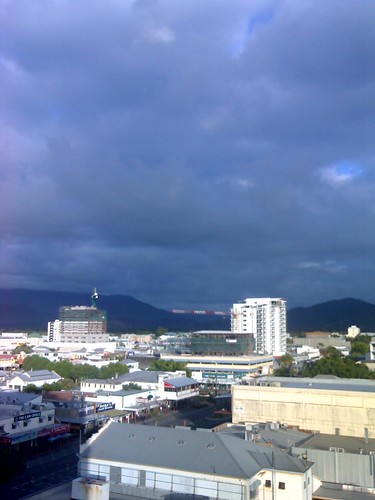
This morning over the ranges
While I've only hung around in the CBD, I've enjoyed what I've seen and experienced: the heavy grey clouds that descend from the hills ringing Cairns and stifle us with the humidity without a single drop of rain, the blasting sun and humidity of 32 degrees C days, and how with the refreshing cool that sunset brings, the lorikeets
roosting in trees in the centre of town deafen passers-by, while the flying foxes ghost silently above us on their way to their breakfast.

And I've very much enjoyed how culturally mixed Cairns is: with the strong presence of Aboriginal and Torres Strait Islander people, tourists and backpackers, and the particularly the Japanase holiday who choose to make Cairns home for few months and work in the hotels, shops, Japanese restaraunts etc, giving me a contemporary impression of what Thursday Island and Broome would have been like at the height of the Japanese involvement of the pearling industry.

On all this, hopefully much more once I get settled when I'm home again.

Labels: , ,


Read more!

Wednesday, October 01, 2008

Lemmings or wildebeest?

Wildebeest Stampede
In case you need further proof that stock market traders and other capitalist flunkies are a bunch of lemmings collectively hurling themselves off the cliff – taking our superannuation savings with them – in a fit of irrational fear, then heed the words of these scientists.

Paul Zak of the Centre for Neuroeconomics Studies at Claremont Graduate University in California says, "There is this sort of herd mentality over-reaction".
"I am not a financial genius. I do know that when you see millions of people in the market essentially freaking out, that spills over into your brain and you get this impulse to do what everyone else is doing," he said.
I just wonder if these traders and investors are wildebeest stampeding to escape predators or base-jumping lemmings. If they are just wildebeest, they'll stampeded until they tire themselves out and look around sheepishly when the dust settles. The irony is they are terrified of the results of their own handiwork.

Labels: , , ,


Read more!

Monday, September 01, 2008

Homage to Analogue #1 - film photography

A photography course I took earlier this year reacquainted me with the joys and tribulations of shooting photographs on 135 mm photographic film and using old manual SLR cameras.

Reflecting on my experiences, I came to see waiting as one of the defining aspects of film photography and how it is different from digital photography. It is a slow process, and a slow technology.

And so I was inspired to write a series of posts in homage to ‘analogue’ technologies, with this, the first, a homage to 35 mm film photography.

I learned that taking photographs on film is an exercise in patience – each roll had to be finished and developed before I could see the results. However much I wanted to know immediately if my tinkering with framing, composition and exposure had worked out, I was forced to wait.

After collecting the developed roll, I would flick through the envelope of prints and flinch at each debacle of composition, focus, exposure, or colour. Many were just silly errors. It was frustrating.


When things went well, amongst the wasted shots would be a few gems where the right confluence of light, composition and subject would emerge from the emulsion. And with that would come a great sense of accomplishment – made all the sweeter by the waiting and the length of the process.


I wouldn’t discount how much of it was pure luck, though.


With film, there is none of the instant gratification of digital photography. There’s no seeing if you got the photo right on the tiny LCD screen. And there’s certainly no opportunity to plug the camera into your computer to download and view the image files, tinker with them in photo editing software, delete the duds, file the rest away on your hard drive or burn them onto CD, and, if you’re lucky, print off a few on your home inkjet printer.

Using film also requires more deliberate, intentional activity. Some of this relates to using a manual SLR film camera, where one has to turn dials to set exposures (and wind on film), turn the lens barrel to focus and pressing the button to release the shutter.


But most of it stems from the high cost of buying and developing rolls of film. With each frame costing money, I was less inclined to snap away over and over again at the same subject to try out different approaches in the hopes of getting the perfect shot – or just getting it right.


This is certainly different from digital photography, where you can take however many images as your memory card – or batteries – will allow. And where you can view and delete files and reshoot the photo to hopefully get it right. After all, a digital image is only a series of 1s and 0s, rather than dollars and cents.


Instead, when shooting on film, each frame has to count, each exposure worked out, and each framing and composition planned, often with fingers crossed. Sure, while doing the course the deliberate technical learning played a big part in slowing me down, but cost was never far from my mind. More often than not, I would not take the shot – especially if the elements didn’t come together.

I’m sure many of you would have stories to share about the photographs you didn’t take, rather than ones you didn’t. It would be interesting to compare which instances are most remembered.


Film photography is well-suited to the ethos of the Slow Movement, which encourages us to ease up our frantic, frenetic lives, and embrace slowing down and forging more meaningful connections with other people and with what what we are doing. The patience-teaching, deliberate activity of taking photographs on film, having them developed and sorting, storing and admiring the prints can still be enriching – even if all it does is get us to slow down.


For all the frustration and enforced patience of film photography, it is a beautiful form. It can be like a meditation, and for every two or three duds, the good shots shine brighter. It requires time. And effort.


What are your favourite film photography moments, memories and photographs?


Update: now cross-posted at Sarsaparilla, where I have been invited to to be a contributor! Cool! Thanks,
Sarsaparilla! [Updated 3 September 6.30 pm]

[Photograph is one of mine, taken of my older son at Collingwood Children's Farm, on 400 ISO 35 mm film, on an old Minolta 100 ST manual SLR. Not one of my best, but illustrative]

Labels: , , ,


Read more!

In Praise of Analogue


When I did an SLR photography course earlier this year, I was the only one in the class who was shooting on film. The rest had digital SLR cameras. Though I felt like a dinosaur at the start, I learned to appreciate many things about film photography.


It also got me reflecting on a range of other technologies and media that have been superseded by digital technology – what you could call ‘analogue’ technologies, for lack of better word. And I was inspired to write an occasional series of posts in homage to ‘analogue’ technologies.

It is not a new use of the term, of course. Many have long described pre-digital technologies as analogue, after how clocks with hands were distinguished from digital ones. Analogue has become a very handy catch-all phrase.

There is a wide range of pre-digital media: 135 mm photographic film, black and white film, cassette tapes, video, vinyl records and even letters.

And there are many more technologies that have receded into our not-so-dim past: pre-electronic SLR cameras, transistor radios, reel-to-reel audio recorders, dial telephones, typewriters, fountain pens, and even the lowly pencil. And potentially cathode-ray tube TVs.

This won’t be an exhausting survey, but an idiosyncratic exploration drawing on my own experiences and reflections. So while I am not covering things many things, that is not stopping you from doing so, either in the comments or in your blogs.

The first in this ‘Analogue’ series will be a homage to film photography, so stay tuned.

What sets these technologies apart as analogue is that each has been superseded to some extent by a digital equivalent.

More significantly, analogue technologies are much, much slower than digital technologies. The speed of digital made it so much more appealing than the analogue equivalents. Paradoxically, in our fast-paced digital world, slowness is now what is increasingly appealing about analogue forms.

I’m no technophobe. I have enjoyed the digital revolution tremendously. But exploring analogue technologies offers a richness – not only of tapping some sentimental past, but of exploring new ways of experiencing and appreciating our world today.

[Image: photograph published by Library of Congress on flickr, no copyright]

Labels: , , , , ,


Read more!

Saturday, August 23, 2008

Melbourne Writers Festival this week

I'm going to some of the sessions of the Melbourne Writers Festival, which opened yesterday. I missed out on the opening address – Germaine Greer's keynote sold out pretty early, I gather, but it would probably be enough to read the extended essay and follow the broo-ha-ha in the media.

I'm unable to go to as many sessions as I'd like, but I'm fitting in what I can manage under the demands of juggling caring for children with my partner, work and school.

Also cost was a factor – prices went up this year, despite earlier promises of a more expense-friendly festival with its move to Federation square. I was pretty annoyed that they did away with the discount for those buying five tickets or more, and replaced it with an early bird discount, which ended on 2 August – twenty days before the festival began! That wasn't much help to those of us who had to wait for paydays and to scrape together the money, or chronic procrastinators, or busy people who don't check out programs or purchase tickets that early – and I fit all those categories...

So what am I paying my hard earned money to attend? I'm going to hear short story writer and literary editor Nam Le (of The Boat fame), and watch Salman Rushdie on the big screen – beamed live from Edinburgh. Both are tomorrow night – and I mean 'night'. The festival is pushing events later and later to squeeze more in, though it could be more to do with international timelines and the satellite connection with the Edinburgh Festival (the session with Nam Le is being shown at the Edinburgh Festival by satellite).

I'm also looking forward to hearing Chloe Hooper, Gideon Haigh and Nicolas Rothwell discuss the essay and compare writing non-fiction books and articles (Saturday 30 August). I love a good essay, and am a fan of the art writing essays. I really enjoyed Hooper's essays on the Aboriginal death in custody on Palm Island, on which her new book Tall Man is based. Haigh is also an established essayist and non-fiction book author, so there will be a lot to hear and think about. I think I've only read a couple of Rothwell's articles in the papers, but I'd like to hear what he has to say.

I'm looking forward to these sessions. I'm also going to try to make it to some of the free Festival events where I can, including the Creative Commons-licensed creative writing re-mixing events (more on that in a later post - promise).

If you're going to be at the Writers Festival at any of the times and sessions I will be, and if you feel like it, drop me a comment and we could meet for a coffee.

Labels: , ,


Read more!

Friday, August 15, 2008

Children's book honours kicks off children's book week

The Children's Book Council announced this year's winners of its annual children's book awards this afternoon. Melbourne author Sonja Hartnett won the award for book of the year for older readers for her latest work, The Ghost's Child (published by Penguin Australia).

This tops off a fantastic year for Hartnett, who earlier won the Astrid Lindgren Memorial Award, the world's richest award for literature for children and young adults.

I remember reading a press report of the awards ceremony in Sweden in May where Hartnett commented that children's writing, and children's authors, are not take as seriously in Australia as they are in Europe (despite hunting, I couldn't find the story online). I'm uncertain how telling an indicator of this it would be, but it would be interesting to see if The Age's Saturday arts, books and culture supplement, A2, will cover the Australian Children's Book Awards winners in its edition tomorrow. Or how much.

Bookwitch has a story on Hartnett's Swedish prize adventures and her writing.

Here are the other prize winners for this year's Children's Book Awards:
Carole Wilkinson’s Dragon Moon won the prize for Younger Readers, while Aaron Blabey’s Pearl Barley and Charlie Parsley won Early Childhood Book of the Year.

Meanwhile, Matt Ottley’s Requiem For A Beast won the Picture Book of the Year, an award Shaun Tan
won last year for The Arrival. The Children's Book Council (and various booksellers) have to keep reminding buyers that the Picture Book of the Year is not necessarily suitable for all age groups – as picture books are not just for young children!

What I found pretty interesting about this year's awards is that the winner of the Eve Pownall Award for Informational Books was a book about books – Parsley Rabbit’s Book About Books, by Frances Watts and illustrator David Legge.

I haven't come across it before, but the ABC Shop’s website describes it this way:
“Celebrate the joy of reading and begin a lifelong love of books with the delightful Parsley Rabbit and his pesky little brother, Basil. Lively and entertaining, it features a remarkably clever and handsome rabbit and is full of fun, flaps to flip and questions to share. Parsley introduces children to books - from the cover, to the imprint page to the title page, formats, style and more - and takes the reader on a hilarious and stimulating journey through the world of books. An absolute treasure of a book for children from 3 – 7 years."
What a wonderful way to introduce children to the art and process of making and enjoying books, and not just reading them (or having them read).

And a wonderful way to kick of this year's Children's Book Week (also a CBCA initiative), which starts tomorrow. It is a week of activities that lots of book stores, schools, libraries and authors and illustrators get into each year to encourage the joy and wonder of books in children and to celebrate books for children and young people. But this is not just something to be left to teachers, librarians,
authors and illustrators.

This year, I'm going to buy a couple of children's books for my two sons and add them to the long lists of books they enjoy reading/having read to them each evening.

What are you going to do for Children's Book Week this year?

Labels: , , ,


Read more!

Friday, August 08, 2008

Why did the chicken cross the road?

This morning I dragged my sorry ass out of bed at 4.10 am so that I could catch a train at 5.06 in the pitch dark. It was freezing.

It was so early, there were only seven of us on the platform catching the train into the city – only the second service of the day. I was off to join
ABC 774 FM's Breakfast celebrations at Federation Square of the impending opening of the Beijing Olympics.

I won the opportunity to enjoy a Yum Cha breakfast as part of the Breakfast Show (with presenter Red Symonds and three dozen or so other listeners and such) by calling the radio station and offering to eat chickens feet (Yum Cha style) live on air during the feast and talk about it. I was pretty excited when they said yes. Having to be there at 5.30 am did put a bit of a dent in it though.

I normally enjoy eating chicken feet – it is quite the delicacy – but I knew that it would get the attention of queasy white-Australians, who still hold many aspects of Asian peoples' food in total horror, and get me a free lunch. Or breakfast.

For all their our pretenses to epicurean cosmopolitanism,
Melbournians still prefer many aspects of Asian food, or for that matter many other cuisines, be sanitised for Anglo palletes. And white Australians still make fun of Chinese, (and Vietnamese) food, with not so veiled jokes about dogs, snakes, bulls 'pizzles' in Vietnamese noodle soup, and chicken feet.

And you know what? I milked it and got a free meal. Not unexpectedly, there were no chicken's feet on the menu for yum cha this morning, nor any sliced tripe with honey and ginger, or any sticky rice in lotus leaf parcels
(I do draw the line at shark's fin, though). These are the kinds of things that Chinese families, and those assorted others who have had their culinary horizons opened beyond Melbourne's pretentions, usually enjoy about Cantonese style yum cha. Pity. Still, I enjoyed myself a lot, and the food was good. And I got to see, and meet, the people behind the voices I hear on air nearly every morning.

I wonder if 774 will offer witchetty grubs at a bush tucker feast next. Would you believe, I ate mangrove worms just the other day?

[Image (cc) by alasam]

Labels: , , ,


Read more!

Wednesday, July 16, 2008

Thought-quote for the day

Alex Steffen, in his recent WorldChanging post The Apocalypse Makes Us Dumb writes, "Disasters … are all about bad food and wet feet and sick babies and pointless pain."

There is much to reflect on in this very good post that questions the millennial assumptions of the 'end-of-the-world-as-we-know-it' thinking, particularly that related to global warming.

My other favourite idea/quote is "The Apocalypse will be an adventure." As he says, it won't. Well worth mulling over.

A good post to read in tandem with his post on who the heroes in a climate-changed world would be, which I've responded to in my Twitter updates (see 'Twitter updates' section in the column on the right).

Labels: , , ,


Read more!

Thursday, June 12, 2008

On a winter's night…

Winter is doing strange things in Melbourne currently. One day, it is all foggy mornings and grounded or detoured aeroplanes, the next it's sunny afternoons followed by rain clouds chased over the ranges. All the same, there is something quite lovely about they way this city faces winter. Lots of people get into the winter mood around here, and incorporate its features into not just their dress and cooking, but into art, writing, and more.

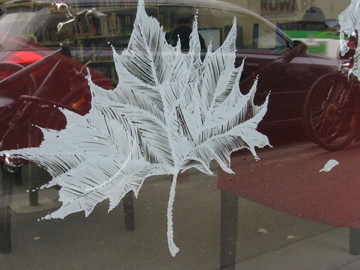
leaf
I took this photo of a hand-drawn leaf a couple of weeks ago. It is part of an extended artwork on the glass wall of the local municipal library near my work. It is a lovely meditation on plane trees and the way they lose their leaves for the cold weather, if a bit melancholic.

Winter's melancholy can play havoc with many of us, but then there is always something to cheer us up. Like the sun breaking through the clouds, or burrowing into bed with something lovely to read, such as the latest issue of Meanjin – the first under the stewardship of their new editor Sophie Cunningham. It's worth reading, from all reports, and not just because it features work by the wonderful bloggers Ampersand Duck, and Laura Caroll, who are also behind Sarsaparilla.

Winter is also a great time for a big hearty stew or soup, or maybe a curry, and a nice glass of red. I know what I'm picking up from the shop on the way home.

Labels: , , , ,


Read more!