Wednesday, July 08, 2009

Manna from heaven

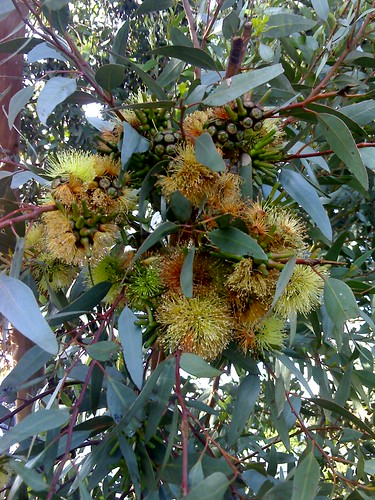
Gumtree blossoms on a cool wet morning

This afternoon I went along to a NAIDOC Week event hosted by a bunch of federal government departments. It wasn't the most community-oriented event I've been too – it appeared mainly targeted at those in community services or public service departments and agencies who work with Aboriginal and Torres Strait Islander communities in Victoria. I went to this event for work reasons.

It was still good because there were a fair few Aboriginal and Torres Strait Islander people working in either federal public service delivery or Victorian community agencies there, and it was good to meet and greet and see some faces behind the organisation's names.

But the nicest thing about the event was the speech and Welcome to Country by Aunty Joy Murphy, a highly respected elder of the Wurrundjerri, the traditional owners of the land on which most of Melbourne is on, and certainly of Fitzory where the event was held.

Aunty Joy treated us to a potted history of the elders behind the movement for Aboriginal rights in Victoria and the beginnings of NAIDOC, and how Fitzroy has been an important location for Victoria's Aboriginal rights movement and community-controlled services since the early 1900s. But it was her welcome message that gave me the most food for thought.

After she welcomed us in language, Aunty Joy told us that part of the welcome was based the importance of the Manna Gum to her family and the
Wurrundjerri people. Bearing a branch of green lush Manna gum leaves from her traditional country near Healsville, she explained that the welcome invited us to share in the community and its country – from the very tips of the gum leaves high in the sky, down to the roots deep in the earth.

Being someone who likes to visualise things figuratively, this appealed to me a lot. It is lovely to think of sharing in a thousands-year-old culture and its connection to the land in this way. To imagine our connection to the air and the leaves reaching out through it, as well as to the earth via the roots.

It also makes me wonder a fair bit about what we're doing to our ecology and to the climate in our carbon-intensive society.


Friday's NAIDOC March and Rally will be quite a different event – with lots more community, and certainly more issue and politically based – but I value this opportunity for reflection today. Thanks, Aunty Joy.

[Image: The photo is of eucalyptus blossoms I took at my suburban train station a little while ago. I have no idea what type of gum, though.]

Labels: , ,


Read more!

Tuesday, July 07, 2009

Everyone should celebrate NAIDOC this week

It's NAIDOC Week this week, a time for celebrating Aboriginal and Torres Strait Islander cultures and communities. The week is also a great opportunity to highlight the strength that culture and community offer Aboriginal and Torres Strait Islander people.

There's a lot that you can do to join with Aboriginal and Torres Strait Islander communities in celebrating NAIDOC Week.

This year's NAIDOC theme, 'Honouring Our Elders, Nurturing Our Youth', highlights the importance the community places on its Elders and its young people. It is important to acknowledge Elders and the role they play in supporting, teaching and guiding young Aboriginal and Torres Strait Islander people, many of whom are struggling to find their feet and their way forward.

Brian McCoy's excellent reflection on this year's theme captures this point very well. McCoy, an anthropologist specialising in Indigenous health and well-being who has worked with desert Aboriginal communities for a long time, shows how important NAIDOC week is – not only to Aboriginal and Torres Strait Islander peoples but to all Australians.

Considering last week's report on Indigenous disadvantage, the latest in a long line of official reports that highlight the growing gap in disadvantage between Indigenous and non-Indigenous people in Australia, this is an important demonstration of community strength and support. It's a way for many communities to show that they can make a difference, and are making a difference, for the better.

And it's an important way for non-Indigenous people to show their solidarity with Indigenous communities on this matter.

There are lots of NAIDOC Week events across the country. You'll find a calendar of events if you pick up a copy of the country's only Indigenous controlled national newspaper, the Koori Mail. You can also get information from local NAIDOC committees and Indigenous groups.

If you’re looking for a NAIDOC event in Melbourne, the NAIDOC March & Rally is on Friday 10 July. The march starts off at the Aboriginal Health Service on Nicholson St, Fitzroy at 10 am and makes its way to Federation Square.
More details here.

Labels: , , ,


Read more!

Tuesday, May 26, 2009

Australian filmmaker wins Camera d'Or

Congratulations are due to Warwick Thornton, whose first feature film Samson And Delilah has been awarded the Camera d'Or prize at Cannes. The award is for a first-film by a first-time film director.

El from elswhere has previously reviewed the film and its Extraordinary premiere in Alice Springs at Sars Lite, and I highly recommend it to those who missed her post.

I am somewhat disgruntled, though, that the media keeps referring to Thornton as an Aboriginal filmmaker. I know, and respect the fact, that Warwick Thornton is a proud Aboriginal man, who is strongly connected to his family and community in Alice. But why aren't Australians, and our media, ready to simply celebrate our writers and filmmakers and artists and musicians (and their achievements) as art makers first and foremost, and then, yes, Australian, and, yes, certainly Aboriginal or Torres Strait Islander if they are of that background?
[Yes, there's more! Click on 'Read more' to read the rest of this post!]

Why are the media reports of his win constantly referring to 'Aboriginal filmmaker Warrick Thornton'? Why not 'Australian filmmaker'? Am I too sensitive in presuming an undercurrent of 'wow, he's managed to win it despite being Aboriginal'?

Is Thornton being Aboriginal the story, or is how good a film Samson and Delilah is the story?

Yet Samson and Delilah is constantly referred to as an Aboriginal film. Surely it is that but more, and everything else besides? Thornton himself considers it a love story first and foremost (and at least The Age picks that up in the headline 'Australian love story wins Cannes prize'), and yes its actors, characters, setting and plot drivers are Aboriginal, but surely this is not a only, or purely, an Aboriginal film?

If anything, the jury at Cannes seems to get it, describing it "as the best love film they had seen for many years."

I don't doubt that Thornton being Aboriginal is important to his approach to and success in the film – possibly securing him access to country, actors, community support, and certainly the context for the story – and it is unlikely that non-Indigenous filmmakers would have had the opportunities and entrepoints to make this project a success (though that is debatable, looking at David Vadiveloo's success with the online film/multimedia production UsMob). I have no doubt that being Aboriginal is important to Thornton, and has informed and coloured his practice as a filmmaker.

But perhaps, first and foremost, Thornton is a very fine filmmaker. And he was won a major prize at Cannes.

You can hear Thornton speaking to the ABC's Lisa Millar (links to audio mp3) about his reaction to his film winning the Camera d'Or and, endearingly, how he's ready to come home from the red carpet glitz of Cannes to reality and sit on his veranda in Alice Springs .

Cross-posted at Sarsaparilla Lite.

Labels: , ,


Read more!

Thursday, May 14, 2009

The one about the budget

Instead of twittering away my thoughts and ideas and never get around to committing them to this blog, I'm taking a leaf out of the Blogging Amnesty inspired by Crazybrave and others and getting down my ideas, however short, about the federal Labor government's budget. And I'm going to pinch outrageously from others' thinking to do so. That's the original beauty of blogging, isn't it?

According to The Australia Institute's early budget analysis sent to subscribers of its email newsletter, the budget is 'all sizzle, no sausage'. They pretty much capture my thinking about it where they distill the the Good, the Bad and the Ugly of the second Labor budget:
The good: Paid parental leave
The bad: More money for the fossil fuel industry than for the renewable industry
The ugly: Those who missed out—sole parents, the unemployed
I support the paid parental leave, but I want it rolled out sooner.

On the ugly side of the ledger, I'd add that there's no really significant spending to address Aboriginal and Torres Strait Islander disadvantage. I'm increasingly concerned that 'Close the Gap' is going from being a powerful rallying point for social-justice for Aboriginal and Torres Strait Islander people to being a feature of the Rudd spin-cycle that masks Labor's lack of significant action in addressing Indigenous disadvantage.

In a subscriber only article for Crikey.com (so I can't link to it yet), Jon Altman of the Centre for Aboriginal Economic Policy Research says:
“This Budget is about maintaining the status quo with the hope that economic recovery will see Indigenous re-engagement with the mainstream. This is a limited vision that might in itself not accord with the aspirations of Indigenous Australians. If the goal is to close the gaps, this approach just will not be enough.”
The other sorry-ass problem with the Rudd/Swan budget is that it fails to invest enough in renewable energy and climate change initiatives – but favours carbon industries and initiatives instead.

As The Australia Institute says:
The new solar flagship program is a scheme designed to establish as many as four solar energy projects generating electricity for the national grid with capacity up to 1,000 megawatts. The budget papers admit that that is merely the equivalent of one coal-fired power station. This project should not be sold as anything other than a modest initiative.
I think that Crikey.com's John Hepburn (the whole article is worth reading) says it a lot harder – and more accurately:
Of course, the decision to give another $2billion to support the coal industry is just a political sop to an industry that has the Government over the barrel.
Is this corporate welfare to the coal industry really worth the giant deficit the government is trying to convince us is needed to secure jobs? Surely we need more green jobs, rather than carbon jobs. What worries me is whether the government is going to have us over the barrel soon.

Labels: , , , ,


Read more!

Thursday, April 16, 2009

Help Save Reconciliation Victoria!

I just want to quickly share the news of this very important campaign. I got this call to action via email from ANTaR Victoria, and because I believe that the work of organisations such as Reconciliation Victoria is so important, I want to urge you all to help by taking whatever action you can:
Reconciliation Victoria (Rec Vic) is currently facing the possibility of forced closure, having received no future funding commitment from the Victorian Government for the coming financial year.

ANTaR Victoria is supporting Rec Vic in its cause, calling on the Brumby government to provide ongoing and increased funding, as a key aspect of its closing the gap strategy. In addition to this, ANTaR and RecVic are asking for your help to put pressure on the government, as it is only through organisations such as RecVic that the hard work of changing community attitudes can happen to make Victoria a culturally safe place for Aboriginal and Torres Strait Islander peoples.

Learn more about how you can help save Reconciliation Victoria.

I'm taking a quick break from a terribly busy time at work, so apologies for a lack of details. When things settle down, I'll provide an update on the campaign and share why I think such organisations should be supported.

Labels: , , , ,


Read more!

Monday, May 26, 2008

"We've come home, now"

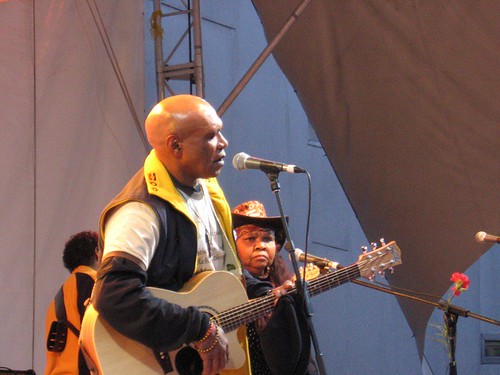
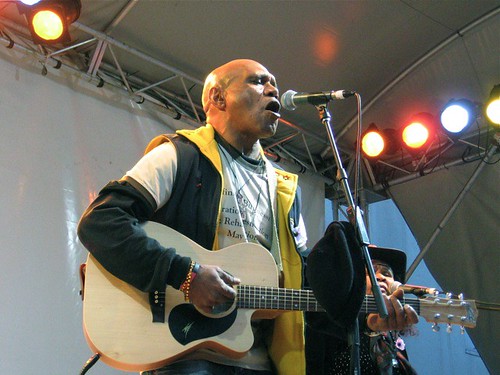
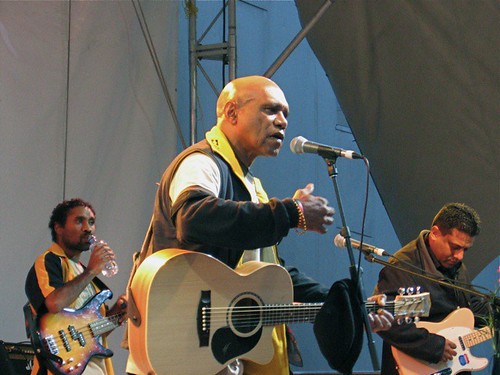
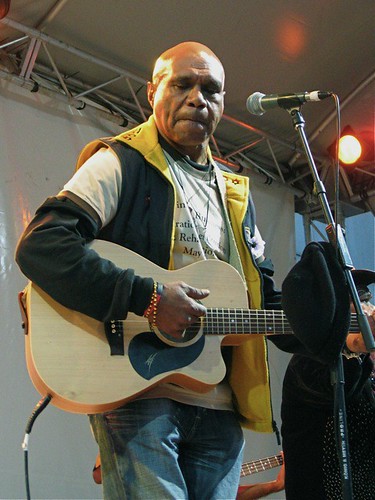
Archie Roach and Rubie Hunter play for the Sorry day commemorations
Today was Sorry Day – the tenth anniversary of the first Sorry Day, in fact. Part of Melbourne Aboriginal community's commemorations this day was observing this anniversary and reminder of what they have been through.

It also served as a reminder to the non-Indigenous community that despite the federal government's national apology to the Stolen Generations, there is much that needs to be done to address Indigenous disadvantage in this country – not the least of which is financial compensation for members of the Stolen Generations, as part of the full reparations to them recommended by the Bringing Them Home report.

Archie and Ruby
Archie Roach and Ruby Hunter, with their band, performed at Federation Square in the late afternoon as part of the commemorations, and as usual their performance was powerful.

Archie Roach in song
When Archie started to sing 'Took the children away', all those present went up to the foot of the stage to place a white flower on the wreath that was placed there to commemorate all those who had suffered the removal of Aboriginal and Torres Strait Islander children from their families – those stolen passed and present, and their families who suffered unbearable loss. It was powerful moment. And not one I wanted to spoil by taking photos of.

Archie Roach and band
Archie also spoke about how important being a father and being part of a family is to him now, particularly in light of his experience of being a member of the Stolen Generation. I'm uncertain if the lyrics were in the original version of his song, but Archie now finishes the song by singing "We've come home, now", from which the title of this post is taken. The roar of approval and applause from the crowd sent a chill down my spine.

Archie Roach

Labels: , , , , ,


Read more!

Thursday, March 13, 2008

Racism is alive and well in Australia

Despite the current media and online outrage, I am not surprised that a month after the National Apology to the Stolen Generations we are hearing reports of racism against Aboriginal people in Central Australia. Appalled and outraged, but not surprised.

A group of young women and children were asked to leave an Alice Springs backpacker hostel because they are Aboriginal – within a short while of their checking in and taking their luggage to their rooms. The group of young women leaders from the Central Australian Aboriginal community of Yeundumu had been brought to Alice Springs by the Royal Lifesaving Society, who had booked the accommodation for them.


According to ABC news online:

The group included several young mothers and a three-month-old baby. Most were young leaders, chosen specially for their standing in the Yuendumu community.

The resort manager told Bethany Langdon from the Yuendumu Young Leaders program the group would have to leave.

“The manager came out and told me that we weren’t suitable to stay there,” she told ABC1’s Lateline program.

“They said, because you’re Aboriginal, other tourists were making complaints that they were scared of us.

“I felt like I wanted to cry, because it made me feel like I wasn’t an Australian.”

Ms Langdon says it is her first experience of overt racism.

"It's a disgrace against Aboriginal people, especially when an Aboriginal women comes into town trying to be a role model to their community and get looked up to by elder people and younger people from their community and other communities," she said.

The Royal Lifesaving Society was obviously unaware that certain hostels and hotels in Alice Springs have racist policies of not allowing Aboriginal people to book and stay with them, or that this hostel – Haven Backpackers Resort – was one of them. Judging from what I've heard from people who know Alice, this racist practice is common.

The Hostel's manager disputed that they were asked to leave because they were Aboriginal, denied such a policy exists, and claimed that the reason was that other guests at the hostel had made complaints about the Aboriginal women, and that the hostel is intended for international guests. The manager also claimed that the women left of their own accord, and that the hostel arranged
alternative accommodation for the women.

Now a former employee of that hostel has reported to the press her first hand knowledge of the hostel's racist policy of denying bookings and refusing accommodation to Aboriginal people.


The Royal Lifesaving Society had brought the group of young leaders to Alice Springs to learn life saving so that they can return to their community and act as life guards when their new swimming pool opens. Despite initial concerns that this experience would tarnish and undermine the Society's efforts to work with local Aboriginal communities, the picture above suggests that the woman are persevering with their lifesaving training – clearly a strong indication of their leadership qualities!

Apparently, the hostel is now facing lawsuit after telling the women to leave. It would be just as important for a complaint be taken to the Anti Discrimination Commision by the women against the hostel. Hopefully, this will open the big can of racist worms that is the tourism industry in Central Australia. And the Northern Territory overall, and Australia more widely.

Tigtog and Lauredhel at Hoyden About Town have led the charge in reporting this matter in the bloggerspere, and joined in the call for a boycott of the racist hostel, and for bloggers to help publicise this issue and the boycott online. In that spirit, I'm reproducing here this statement from them, which, it is suggested, is also intended to screw with the hostel in question's google search rankings:

Ethical tourists please avoid the Haven Backpacker Resort on Larapinta Drive, Alice Springs: it is a racist establishment, please don’t support it by staying there.

If it is true that this instance is just the tip of the iceberg, and that this practice is widespread in the Northern Territory tourism industry, and in Australia overall, then this should be only the start of a campaign to take the tourism industry to account for the way it capitalises on the appeal of Aboriginal culture and heritage to make its money, but gets away with treating Aboriginal people this way. The truth is, outrage that this should actually happen in 'muticultural, post-apology Australia' not withstanding, the racism experienced by Aboriginal people is very real, and quite widespread.

The apology was never meant to be a panacea. It is a first step. How we deal with the dirty reality of Aboriginal people being denied services and discriminated against will be the mark of this supposed new chapter that Kevin Rudd proclaimed in his apology speech (see the Update in that link, which is to my earlier post on the apology).

And while we're at it, let's remember the whole gamut of racism that Aboriginal people experience in the receipt of services – whether in accommodation, travel, or hospitality, where small minded people discriminate against Aboriginal people because they fear and loath them, or in in the provision of essential health, emergency, communication and other services, and the provision of education, infrastructure and employment, something governments are elected to do, but have consistently failed to do so. As we aim to make private enterprises accountable for their racism, so must we make our governments.

[
Image source: it's an SMH pic, which I also found via Hoyden About Town (thanks!)]

Labels: , , ,


Read more!

Wednesday, February 13, 2008

"A beautiful, beautiful day"

The moment so many, many people longed for finally arrived – Kevin Rudd, as Prime Minister of Australia, and the national parliament this morning offered a formal apology to the Stolen Generations for their removal as children from their families and communities, and the terrible hardship, pain, grief and suffering they experienced as a result.

So many people were feeling excited, but mixed with a solemn sense of remembering, in the lead-up to the apology at 9.00 am. This was particularly so amongst the Aboriginal and Torres Strait Islander communities across the country, but especially the surviving members of the Stolen Generations and their families. There was a palpable buzz around Melbourne this morning as people gathered at various places to watch on big screens the apology broadcast by the ABC from parliament. I heard there was a big crowd at the Aborigines Advancement League and a huge one in Federation Square.

Of course, there was the great convergence of Aboriginal and Torres Strait Islander people and non-Indigenous supporters from across the country in Canberra, and they gathered on the lawns of Parliament House.


I watched it at work with my colleagues and a few other visitors
.

From the text of the resolution that Rudd read in parliament, and his speech in favour of the resolution, it was clear that this apology was pretty much what so many people, the Stolen Generations in particular and their supporters, were hoping for. It was also very apparent from Rudd's speech that he had caught the mood and hopes of people around Australia - Stolen Generations members, others in the Aboriginal and Torres Strait Islander communities, other advocates for Reconciliation and people generally. It was clear that Rudd did 'get it'.

Despite the speculation in the lead-up, Rudd had made it clear that his apology would mention the word 'Sorry'. What was not clear was whether he would bow to the Liberal opposition's pressure to not use the term Stolen Generations in the apology.

Although Rudd was not overly passionate or animated in his delivery – he is clearly not the type of Labor orator that Keating or Whitlam were – he clearly showed respect to the Stolen Generations, and honoured their pain and suffering, and was sincere in his apology in terms of his words and intent. It was also clear that he was speaking to them, to the Indigenous community overall, and to the whole of the nation as well.

On the other hand, I could barely bring myself to keep listening to Opposition leader Nelson's speech. I thought it mean-spirited, terribly insensitive, and had many comments that were so out of place for this event. It was terribly narrow because it, in the main, appealed to the Liberal party faithful, rather than the people of Australia as a whole, or the Stolen Generations directly. I wasn't sure if Brendan Nelson just didn't 'get it', as some people suggested to me, or that he did get it but was capitulating his moral beliefs for his leadership and position in the party and saying what the party wanted to hear from him. I am still making up my mind which is worse. Ultimately, it was Nelson's lost opportunity, and ultimately the Liberals' lost opportunity.

All the same, if you consider how over the last 10 years of the Howard era it seemed impossible to imagine this national apology by the government - and the parliament - actually happening, Nelson's position was not surprising. It doesn't make it less distasteful.

The strength of feeling by people across the country against Nelson's mealy-mouthed speech is quite clear. But it was most clearly demonstrated to me by an event this afternoon.

I had gone down to Federation Square this afternoon with my colleagues to catch the last half-hour of the free concert – to hear Archie Roach and Ruby Hunger perform – to celebrate the apology. W
hen I was catching the tram back to work from Federation Square, a rather distinguished looking elderly man waiting for a tram saw that I had the Aboriginal flag on my t-shirt, and started to ask me how I felt about the apology. Unsure what reception I'd get, I told him I was happy about it. He then told me how pleased he was at Rudd's speech and the apology, and how disgusted he was at Nelson's speech. He wished me well and popped on his tram. I was touched that this apology had reached out to touch so many people that I wouldn't have expected it to.

Later, when I got back to work and trawled through the internet coverage of the public reception to the apology and the speeches, and saw footage of crowds, clearly upset at
Nelson's words, booing him and turning their backs to him during his speech, and there on screen I saw the same elderly man with the shock of white hair yelling 'Get him off' at Brendan Nelson!

However bad people may be feeling, and however much we may resent Nelson for stealing this day's attention from the Stolen Generations, all in all we know that this day means so much to the Stolen Generations, and Kevin Rudd helped make that possible.

As Archie Roach said to us as he wrapped up his set at Fed Square, "it's a beautiful, beautiful day!"

––––––––
Update: The full transcript of Rudd's speech is available for download (PDF) from the Parliament website. However,
if that link stops working (for instance if the Parliament House website people move it off the front page and the link breaks), you can download it (PDF) here instead. You can also hear/download (MP3) the audio of Rudd's speech off the ABC website.

I've added the image above to capture how I feel about the moment. It's off The Age website, photo by Glen Mccurtayne.

[Updated 10:47 am Thursday 14 February 2008]

Labels: , ,


Read more!

Wednesday, June 27, 2007

The white man's burden: Howard's attack on Aboriginal self-determination

Howard's 'new paternalism' is one of the most far-reaching attacks on Aboriginal self-determination in recent years.

One of the most fundamentally troubling things about the Howard government's emergency intervention to tackle child abuse in Aboriginal communities in the Northern Territory is that it attacks and undermines Aboriginal self-determination.

There have been many indications that John Howard finds Aboriginal self-determination and cultural sovereignty antithetical to his values and political worldview. His recent attacks on Aboriginal land rights in the Northern Territory have been part of his overall desire to dismantle the institutions, supports, features and principles of Aboriginal self-determination.
Now, with the declaration of a national emergency to deal with child abuse in the communities, Howard's Indigenous Affairs Minister, Mal Brough, has handed him the means to further undermine Aboriginal self-determination. Unfortunately, the result will be to undermine NT Aboriginal communities' capacity to effectively deal with family violence and the abuse of children in their communities – the inverse of what Howard claims his plan will achieve.

The Howard-Brough plan clearly attacks self-determination through such moves as seizing control of 70 Aboriginal controlled communities and townships in Northern Territory and forcing Aboriginal parents to meet stringent conditions in return for their welfare and family support payments. All this on top of the ‘law and order’ approach of sending in extra police and military to spearhead the ‘campaign’.
This is the ‘shock and awe’ aspect of the Howard-Brough plan, (the overtly militaristic tone in the government spin is no accident).

The most insidious aspect, though, is the giant lie Howard is perpetrating on the Australian public that Indigenous leaders have had 20 or 30 years to tackle these problems ‘their’ way – the 'old' way – and failed, and so now is the time for the government’s, i.e. Howard’s, way – Howard’s ‘new paternalism’.


Apparently, Howard is referring to the twenty to thirty years that Indigenous communities have had various means of self-determination implemented since the Whitlam era. The lie is that Indigenous people’s way – the self-determined way – have had all the time, resources, means and people to address the problems plaguing their communities, but have squandered them and failed and so engendered this crisis in the first place.

By effectively saying 'your way failed, now make way for our way – we will do what is needed to protect children,’ Howard is simultaneously trying to wash his hands of over a decade of neglect, chronic under-funding (and in many cases de-funding), and destabilisation of organisations, initiatives, resources and basic services for Indigenous people by his government, and blame the problem on Indigenous people and their leaders to justify his jackboot actions.

It also allows him the grandiose (or rather grotesque) gesture of taking up the white man's burden and inviting the rest of Australia to join him.

Through the declaration of a national emergency and showy, dramatic moves that emphasize a sense of crisis and urgency, Howard has garnered a great deal of public support for appearing decisive and proactive – to show that finally, 'something is being done to help the children'. And he has pulled a classic ‘Pauline Hanson’ – just as so many Australians bought her lie that a river of money was being soaked-up by Indigenous people rolling in their special privileges, unfortunately so are many members of the public today, by many accounts, buying Howard’s lie that Indigenous people tried but failed to tackle alcohol, family violence, abuse, and dysfunction.


The truth is, there have been many great successes by Indigenous people in tackling child abuse, family violence, and stopping alcohol abuse. The truth is that there are a great many Indigenous leaders who have for many years been identifying the problems – and the solutions – to the Howard government (and governments before his) and calling for national action and funding to tackle the problem effectively and in concert with Indigenous communities and their organisations – to no avail.


Only, if Howard were to admit that Indigenous communities have been offering the solutions all this time, then he would also have to admit that he had failed to support them in ways that counted – that he, in fact, had failed to help prevent child abuse in Aboriginal communities. And that just wouldn’t do for Iron John, would it? Oh, no. Not during an election year. Besides, it’s far more convenient to blame Indigenous people and their self-determination.


Labels: , , ,


Read more!

Running for the hills

When Howard announced that the feds were sending in police and the army into Northern Territory Aboriginal communities to 'restore' law and order, as part of their response to child abuse crisis there, many people anticipated a high level of fear and panic in the communities because of the lack of consultation with Aboriginal communities and their not being involved in what was being planned.

Reports have trickled in of women taking their children to hide in the bush because of their fears that the police will come to remove their children:
An elder of the Mutitjulu community in central Australia says many Aboriginal mothers are taking their children into the sandhills because of fears the government will take them away.
Many anticipated the disquiet, but perhaps not the fear. After all, these are Aboriginal people who would either remember being hidden by their parents from 'the welfare', or being removed themselves, or know of this happening to their own parents, such as in this story recounted to the Inquiry
into the Separation of Aboriginal and Torres Strait Islander children from their families (the evidence recounts practices in WA, but are indicative of those in NT as well):
The welfare just grabbed you where they found you. They'd take them in threes and fours, whatever. The Native Welfare blokes used to come to every station and see where our half caste kids were. They used to drive right down to Port Hedland. Our people would hide us, paint us with charcoal. I was taken to Moola Bulla. The Welfare bloke ... sent his son ... to pick up me and Colin Swift. We were about 5-6 years old, and my mother was allowed to come with us in the manager's car and then he took her away.
– Quoted by Kimberley Land Council in their submission to the Stolen Generations Inquiry, published in Bringing Them Home Report.
Ironicaly,
Howard actually insisted that people in the communities would start to feel safer once the police were on the ground in their communities and keeping the 'hard men' or 'big men' in check, thus freeing people up to approach services for help and support. I think it is tragic, but ultimately instructive, that even 10 years after the Inquiry, Howard just doesn't get it.

If you knew Howard's hard men were on their way (but weren't sure why), wouldn't you pack up your kids and run?

[Image is from HREOC's online version of the
Bringing Them Home Report on the Stolen Generation]

Labels: , , ,


Read more!

Howard’s ‘jackboot’ paternalism – so full of holes

I was left almost breathless once again at Howard’s brazen, whirl-wind moves to set back Indigenous rights and reconciliation twenty years in the name of saving Aboriginal children from abuse in remote communities in Northern Territory. Howard, with his Indigenous Affairs Minister Mal Brough, have declared an emergency to deal with the crisis of child abuse in remote Northern Territory Aboriginal communities, as identified in the NT Inquiry report released last week.

A lot has already been said about it all over the news and blogosphere (in particular see Barista's take on it, Cast Iron Balcony's, and Ken's at Club Troppo).

But in a nutshell: the Howard-Brough plan involves the federal government seizing control of 70 Aboriginal controlled communities and townships in Northern Territory; suspending the coverage of the permit system over access roads, airstrips and other 'common areas'; and banning alcohol in affected Aboriginal communities for six months or more are. At the forefront of are steps to send in extra police, under the leadership of the Australian Federal Police and with army logistical backing, to impose 'law and order' in the communities.


The government will also force Aboriginal parents to meet various requirements to keep receiving their welfare payments, such as send their children to school and clean up their homes and streets, and will remove Aboriginal parents' control over half of what they receive in family support and welfare payments by channeling the payments directly to schools, issuing food vouchers and other restrictions aimed at streamlining welfare payments into expenses for children.

What is clear is that Howard's approach doesn't understand, let alone address, the reality that alcohol and other substance abuse, family violence and child abuse, and the myriad other problems the communities face, arise from the underlying dispossession, poverty, disempowerment and dysfunction Aboriginal communities experience – caused by 200 years of white colonisation in the first place.

Howard assures us that all this has the express purpose of protecting Aboriginal children from child abuse. That is why I find it stunning that in the reports of Howard’s plan, there has been very little identified that is directly about children. Other than forcing all Aboriginal children under 16 to undergo health checks (that may include checks for signs of abuse), and forcing parents to send their kids to school – even though there may not be enough tables, chairs, teachers, books or money in the schools, very little is actually outlined that directly assists children – especially those who have suffered the trauma of abuse.

Strong concerns have been raised that there aren’t sufficient culturally appropriate welfare services or therapeutic treatment services to support Indigenous children who have been found to be abused when the government’s heavy handed medical testing and investigation regime kicks in. (For more on this, see this interview by ABC Radion Melbourne's Jon Faine with National Indigenous children's services leader Muriel Bamblett last Friday. An mp3 is available of the conversation, with her in the last half of the hour.)

It is clear from this, and the many more problems with the plan identified by community organisations and experts, such as the shortage of alcohol abuse treatment and rehabilitation services to cope with those affected by suddenly cutting off the supply, that Howard and Brough’s plan has been rushed and poorly thought through for implementation. This suggests to me that it was adopted for the quick fix it offers them to grab control over Aboriginal communities and land.

Labels: , , ,


Read more!

Monday, May 28, 2007

Probably both

Aboriginal leader Lowitja O'Donohue, a member of the Stolen Generations, slammed the Howard government for failing to implement two-thirds of the recommendations of the Bringing Them Home Report. She was speaking at an event at federal Parliament last week. She said:
"The Prime Minister either doesn't get it, or he doesn't care and I'm not sure which is worse."
I think it's both. She also said:
"There has been a failure of moral authority and ethical leadership in Australia over the last 10 years."
She's definitely right.

Labels: , ,


Read more!

Wednesday, May 23, 2007

Why is 'Sorry' the hardest word?

Wayne Costelloe is one of the people who has signed the National Sorry Day Committee's online petition calling for PM Howard to say 'sorry' to the Stolen Generations. In the petition, he wrote:
My Mother, may God rest her soul was taken away from her mother when she was 2 years old and spent her growing years without her mother and father. He mother, my Grandmother was taken away when she was a similar age and used to break down and cry whenever she'd tell us the Elders used to put mud on her skin so she'd look darker and wouldn't be taken. This is real human history and the impacts it had on our Family are real. What they both went through was horrendous and deserves an apology.
It is time the Government implemented Recommendation 5a of the Bringing Them Home Report – a national apology.

The National Sorry Day Committee (NSDC) has organised the petition calling for Prime Minister John Howard, "in this Election Year, to Say Sorry to the Indigenous People who have been affected by the Forced Removal Policies". I've heard that the petition is due to be sent to parliament tomorrow, Thursday 24 May, so please hurry and add your name to the online petition.

This Saturday 26 May will be the 10th anniversary of the launch of Bringing Them Home, the Report from the Inquiry into the separation of Aboriginal and Torres Strait Islander children from their families.

Considering the totally inadequate response by the Howard government to the Stolen Generations report and its recommendations, especially his refusal to offer a national apology to the Stolen Generations, there is still a lot of unfinished business in this matter. Of the Report's 54 recommendations, the NSDC says only two have been fully implemented nationally. 10 years after the report's release, community organisations, church leaders and the Aboriginal and Torres Strait Islander communities continue to call for a national apology by the Prime Minister.

Personally, I believe that it is never too late to sorry. However, I think it is too late for this Prime Minister.

Labels: , ,


Read more!

Tuesday, May 22, 2007

Remember: the 1967 Referendum and Sorry Day

Awaye!, ABC Radio National's Indigenous current affairs, arts and culture programme, is covering the 40th Anniversary of the Referendum in a special programme.

They've put a number of great resources on their programme website, including audio excerpts from and ABC documentary made and broadcast leading up to the 1967 Referendum.

I think the programme will be broadcast at 6 pm this Saturday 26 May, but the material is already on the website. Check it out.

Saturday 26 May is also Sorry Day, the day for us to remember how Aboriginal and Torres Strait Islander children were removed from their families and placed into care by state authorities – with disastrous consequences for whom we now know as the Stolen Generations. It also kicks off Reconciliation Week. Find out about local Sorry Day–Reconciliation activities in your area on the Reconciliation Australia website.

Labels: , ,


Read more!

Monday, May 21, 2007

More money than sense

I know that Australian home-owners are renovation crazy, but when I heard that PM Howard's dining room is going to get a $540 million thousand renovation, I felt sick. This is the dining room at his Canberra office, by the way, not at the official PM's residence in Canberra, or Howard's prime ministerial residence at Kirribilli in Sydney.

Of course, besides the revolting arrogance of such lavish spending, the thing that really bugs me is that this renovation will cost tax payers more than the amount that is needed to significantly address the problems in Indigenous health a lot of money to allow John Howard to schmooze the captains of industry and his various political bedfellows – including the uranium industry.

What makes me angry about such waste is that the money is sorely needed in other areas, such as to address the crisis in Indigenous health.


Despite a concerted
campaign by Oxfam Australia, ANTAR, GetUp Australia and others to convince the government to commit the $450 million needed to address the significant crisis in Indigenous health, the government's May budget was a disaster for Indigenous health as it didn't go anywhere near enough what is needed.

This just proves to me that Howard's government has its priorities wrong. Is Nero fiddling while Rome burns?

By the way, do you think Howard's trying to scare us?

---------------
Correction:
As a reader pointed out, I made a mistake in the amount that Howard's parliamentary dining room reno was going to cost – it is thousands, not millions! That will teach me to write a post in a rush! I've fixed that up, and removed the direct comparison of the amount to be spent with the shortfall in Indigenous health. The ALP's comparison of the expenditure with the cost of buying a suburban house was probable more accurate. I still think this a serious waste and misplaced priorities. Clearly, many others think so too.

News reports on ABC Radio this morning indicated that Howard was backing out of this expenditure because of the criticism he was getting. It's amazing how a slump in the polls can make the PM more receptive/responsive to 'feedback'.

Labels: , , ,


Read more!

Tuesday, May 08, 2007

Join the Sea of Hands

I joined the Sea of Hands today, and pledged my support for real and effective engagement between non-Indigenous Australia and Indigenous Australia to create change that improves the lives of Aboriginal and Torres Strait Islander people and recognises Indigenous self-determination.

This was on the recommendation of a
commenter to my previous post on the implications of the Howard government's track record of tax cut election sweeteners in their budgets for the deplorable situation in Indigenous health (amongst other things). The picture above is of my hand, which joined many, many others in the virtual arena.

I urge you to do the same.

Labels: , ,


Read more!

Monday, May 07, 2007

Will Costello widen the Gap in Indigenous Health?

While the treasurer Peter Costello is reportedly poised to announce various 'election year sweeteners' in his 12th federal budget tomorrow night, it's worth considering the implications of the government's refusal to spend this money – hence the surplus – and instead cut taxes (in previous years to the rich and upper-middle income earners) in a bid to buy votes.

While both sides of parliament, and business, debates the pros and cons of tax cuts (and for whom), and the media speculates over the extent of Costello's possible spending spree leading up to the elections, it is easy to miss the negatives implications of a governmen refusing to spend public money where it is most urgently required. For instance, it is hard to fathom that last year's tax cuts amounted to roughly the same amount of money that is desperately needed to address the crisis in Indigenous health.

Indigenous Australia's die on average 17 years sooner than non-Indigenous Australians, and Indigenous children suffer a range of illnesses that are avoidable and easily addressed amongst non-Indigenous children.

Oxfam Australia says:
The increase in investment required is modest - evidence suggests that an additional $460 million a year, coupled with carefully targeted policies, would significantly improve access to culturally appropriate primary healthcare to a level commensurate with need.
Oxfam is
one of the large organisations spearheading the campaign 'Close the Gap', along with GetUp Australia and the National Aboriginal Community Controlled Health Organisation (NACCHO). The campaign is channeling public pressure, via online petitions etc, at the government to put desperately needed money into Indigenous health in this year's budget.

You can register your support for the campaign, if it's not too late, but I think we're barking up the wrong tree, considering this government's record.

Labels: , , ,


Read more!

Wednesday, May 02, 2007

What dreams are made of

I thought I'd quickly share some stand-out blog posts I've read recently online – both on the them on Aboriginal dreams and dreaming, of sorts.

Barista has this great piece on the history of the struggle by groups of Aboriginal people in Victoria to establish home and and farming on land of their own choosing – a struggle for self-determination. They formed the settlement at Coranderrk.

And El, at Sarsaparilla, has a thought provoking piece on our capacity to engage critically with Aboriginal art and artists, and about how we could make "value judgements about Aboriginal art and who makes them".

Labels: , , , , ,


Read more!

Friday, January 26, 2007

Unfinished business

Despite the growing years of my living in Australia and my coming to call this country home, Australia Day will continue to remain Invasion Day to me. Instead of a day of 'national pride' – something that I used to think was an anathema to the 'national character' (if there is such a thing) – it is the day that marks when white Australia began its long and brutal invasion and occupation of this land and the displacement – and attempted genocide – of the Indigenous peoples.

Australia Day commemorates the day Captain Arthur Philip landed the First Fleet of convicts, soldiers and sailors at Port Jackson Bay, raised the Union Jack, formed a British penal colony and secured an extension of the British Empire – at the expense of the Aboriginal peoples of the area: the Gadigal, Cammeraygal, Eora and Wanegal peoples.

Rather than pathetic PR attempts to make us taking pride in 'being Australian' and embrace the celebration of Australia Day, about the only thing that has shifted my take on Invasion Day is the current practice of Aboriginal and Torres Strait Islander communities to observe this day as Survival Day – a day to commemorate their ancestors' heroic struggles to survive in the face of colonisation, and the survival of their culture and people. This is important because the abysmal relationship between the Indigenous peoples and mainstream Australia that continues to benefit from the years of colonial disposession has not yet healed. In fact, it festers.

In his Australia Day address, Foxtel chief executive and arts industry figure Kim Williams suggests that reconciliation as one of the most important issues facing Australia .

While a core of his speech looked at the role television and film storytelling play in "developing an understanding of Australian history and identity", he also talked about how that screen-based stortytelling explores meaning, life and purpose between Indigenous and other Australians.

I agree to a significant extent that storytelling – especially in the biggest medium of our times, the screen – helps us to approach the issues that Indigenous and non-Indigenous Australians need to deal with. The fact that Ten Canoes, the first feature length film ever made entirely in an Indigenous language (Yolngu), won AFI awards says a lot about how well it was received by audiences, as well as the quality of the film making. Yet it is important to reflect that it came 218 years after invasion!

Another significant aspect of Williams's address is that Reconciliation is unfinished business. He points out:
In reading the previous 10 speakers and their addresses there was an almost consistent theme – the necessity of effective national reconciliation with Indigenous Australians.
Reconciliation is still unfinished business after 10 years under Howard because it will never be advanced, let alone completed, under his conservative, nationalist – and now openly assimilationist – government.

Survival Day looks like it will need to be a day to pursue the continuing survival of all our cultures – Indigenous and non-white Australian alike – in the face of Howard's new assimilationism.

Labels: , ,


Read more!

Tuesday, November 28, 2006

Aboriginal Land Rights - stop government pressure on traditional owners!

I got this message by email, with a plea to circulate it as widely as possible, and I thought I'd post it in part here because I believe the issue is crucially important, and I'd rather get the news out than worry about editorialising it:
TRADITIONAL ABORIGINAL LAND THREATENED

URGENT MEDIA ATTENTION NEEDED! !

`Basic services such as education and health care are the right of all Australians and should not be used as bargaining chips to pressure traditional land owners to hand over their land on 99 year leases.' James Ensor, Oxfam's Director of Public Policy.

GOVERNMENT CHANGES TO LEASE & PERMIT LAWS ON TRADITIONAL LANDS

On November 30th, traditional land owners are expected to make a decision about the future of their ancestral land. Amendments to the Land Rights Act 1976 will see some of the last standing traditionally owned and occupied lands taken away from Aboriginal people across Australia under harsh Government reforms already underway. Four traditional Aboriginal communities are being targeted in the Northern Territory, (one of which I am currently working and living in, Elcho Island in Arnhem Land), are being heavily pressured to give up control of their lands to a Government body called the ICC on a 99 year lease.

This is an urgent matter, traditional owners and community members have a right to more time and less pressure from the Government to make this decision in just 5 weeks. Most community members and council members are ill-informed about the Bill, due to the heavy use of legal jargon as well as basic literacy barriers. How can we expect these people to make an `informed' decision when they do not understand even the most basic concepts of the Bill?

The proposed lease provisions will effectively take away the rights of the traditional owners to decide who and what takes place on their ancestral lands for 99 years. Companies, services and non-traditional owners will be able to lease land from the government rather than obtaining consent from the land-owners on a case-by-case basis. In effect, the land owners will lose control of their land for four generations.

"The provision for extension of the 99-year leases means that the land may never be returned to my people should this experiment fail," said Aboriginal and Torres Strait Islander Social Justice Commissioner, Tom Calma. "While I believe that economic development opportunities are essential for the well-being of Aboriginal communities, I don't think 99-year leases will provide that economic opportunity."

Under these amendments to the Land Rights Act 1976, what will most likely occur is that previously Aboriginal owned townships such as Elcho Island in Arnhem Land, will be leased to non Indigenous people, and the subsequent leases internally may - if they are lucky or fortunate - go to Aboriginal residents. It is highly unlikely that any Aboriginal from such townships will be able to afford the primary lease. It will provide many white people previously without the opportunity for commercial success to gain it at the expense of Aboriginal communities. It will also make things a lot easier and quicker for the mining corporations to wheedle more pristine land out of Aboriginal communities

Agreement to the lease is voluntary in the sense that it does not have to be taken out, but the conditions resemble the current Government's rules of 'wash the kids' faces or you get no petrol.'

In other words, if they don't do it, they will lose services such as education, health and housing provided as an integral right to all Australians.

In contrast, if they agree to 99 year leases, they will automatically be given...

"Around fifty houses [...] and real jobs [and] if the community is safe and signs up to full school attendance, a no-drugs no-violence policy and agree to a 99 year lease to support home ownership and business development opportunities."

According to the Bill, there appears to be no safeguards to ensure that leases and headleases are approved with ministerial AND land council AND the full understanding of traditional owners and residents who may be affected. The Bill outlines that these things must take place, but goes on to say that the subsection which insists upon these requirements is irrelevant to the legitimacy of the lease should they not take place, as long as 'fraud' is not committed. It seems like a convenient loophole included to be just that; an easy way out of such implicit dealings with the actual people affected.
…
Commissioner Calma said: "I urge the government to postpone the passage of this Bill until there is more detail regarding the impact of the implementation of the legislation and until land owners have been informed and given the opportunity to provide input into this process." "The federal Government has not consulted with Aboriginal land owners on significant aspects of the legislation.'

We are asking for MEDIA ATTENTION on this issue, as it has received very little so far, probably due to the controversy it would ignite.

- That these traditional communities have the right to more time and more assistance in understanding the legalities of the Bill before deciding on the future of their land.
  • That these traditional communities should not be pressured, bullied or used as bargaining grounds.
  • That these traditional communities have a right to be part of the legislative process of making laws about the use of and entry into their communities.
  • That these traditional communities have a citizen right to the decent housing, health, education and business enterprises that are being promised in return for the 99 year lease.
From Sinem (on Elcho Island), via Australians for Native Title and Reconciliation (Victoria)

Those involved in this want lots of media attention on this issue, which has been terribly missing.

More information on the Government's attacks on Aboriginal land rights, via its ammendments to the Land Rights Act, is available from ANTAR Victoria.

Another mainstream group campaigning on the Land Rights issue has been GetUp! Australia.

Labels: , ,


Read more!